Trench Lincs 4th October 2026
Email me at trenchlincs@gmail.com if you would like to become a subscriber
Good Morning,
Welcome to Trench Lincs once again, and how can it be October? The year is suddenly slipping by all too quickly.
I had a very interesting question posed to me this last week from my son, Robert, in Australia. Rob asks; ‘Who is the only man to be awarded a Victoria Cross and a Prussian Iron Cross?’ It was a new question for me and one that I did not know the answer to.
However, a little digging soon turned up the answer, and if you can’t find the answer, then scroll down below.
I have a varied array of snippets for you this week and I hope you will find something of interest.
FORTHCOMING EVENTS.
Next Meeting - Lincoln & North Lincolnshire Branch, WFA – Monday 26th October 2026 - Doors open 7.00pm for 7.30pm start - Royal Naval Association Club, Coulson Road, Lincoln, LN6 7BG.
James Handley presents: "SMS Seydlitz; the ship that refused to die".
++++++++++++++++++++++++++++++
The next meeting of the Friends of the Lincoln Tank Group will be held on Thursday 29th October at the Royal Naval Association Club, Coulson Road, Lincoln, LN6 7BG at 7.30pm
Jonathan D’Hooghe will present a new talk – “The Importance of the Battle of Cambrai and the Men Who Made it Possible”
This talk will take a look at the opening of the battle of Cambrai on November 20th 1917, but more importantly, the talk will examine why it was so important to the BEF and the BEF’s development of warfare, that would eventually lead to the defeat of the German Army one year later, and who were the main characters behind it all?
Everyone welcome, especially new faces. You do not need to be a member of FoLT to attend meetings, but members of FoLT pay just £10 a year and receive £250 of membership benefits from Ancestry and the British Newspaper Archives. It is well worth joining.
+++++++++++++++++++++++++++++
Next Event - Spalding & South Lincs Branch, WFA is on Thursday 22nd October 2026 at 7.30pm.
Full details to follow shortly.
Spalding & South Lincolnshire Branch WFA continues to meet at the Spalding Baptist Church, Swan Street, Spalding, PE11 1BT. Meetings continue to be held in the evenings of the fourth Thursday in the month, and doors open at 19.00 hours for a 19.30 hours start. Meetings are held in a pleasant main room of the Church and there is ample - unrestricted - on street parking in front of the building. Free refreshments are served at the end of the meeting. Finally, please note that, for security purposes the main double front doors are kept locked as we cannot monitor them from our meeting room, therefore, you may need to ring the doorbell located on the single door to the right of the main double doors in order to gain entry.
+++++++++++++++++++++++
The East Midlands (Nottingham) WFA branch will hold their next speaker event on Friday 9th October 2026 at 7.30pm. The branch meets at St. Peter’s Church Hall, Church Street, Ruddington, NG11 6HA and all visitors will be made very welcome.
Dr. Derek Clayton will present: “The Battle of the Sambre: Crossing the Canal.”
A detailed look at the events of the last week of war on the Western Front when the BEF successfully crossed the Sambre and Oise canals.
++++++++++++++++++++++++++++
The Leadenham Military History Group’s next meeting will be on Tuesday 27th October at 7.30pm at Leadenham village hall.
The speaker on this occasion is James Handley who will speak about – “Storm Over Yorkshire – The 1644 Battle of Marston Moor.”
Probably the largest battle in terms of manpower fought on British soil. James will also bring along a selection of English Civil War militaria.
+++++++++++++++++++++++++
Another group who meet at the Royal Naval Club, Coulson Road, Lincoln, LN6 7BG, is the Lincolnshire Aviation Society.
The next meeting of LAS will be held on Thursday 15th October at 7.30pm.
Talk Title – Flying, Fighting & Reflection – The Life of Battle of Britain Fighter Ace, Wing Commander Tom Neil DFC & Bar, AFC, AE
Tom ‘Ginger’ Neil was one of the elite band of RAF fighter pilots who were later to become known as ‘The Few’. During the Battle of Britain, he flew Hurricanes with 249 Squadron, destroying at least fourteen enemy aircraft for which he was twice awarded the Distinguished Flying Cross; he was then just twenty years old. Tom then went with the squadron to help defend the besieged island of Malta, after which he returned home to lead 41 Squadron, the first unit to be equipped with the new Spitfire XII, as the RAF went on the offensive in north-west Europe. He then served in a liaison role with the Americans during and after the D-Day landings. After the war, Tom remained in the RAF and became a test pilot before commanding 208 Squadron, a Meteor jet fighter-reconnaissance squadron, in Egypt’s troubled Canal Zone, for which he was awarded the Air Force Cross. On leaving the RAF, Tom became a successful author and his time was always in demand by the media and public alike as he became a voice and face of ‘The Few’. Tom died in 2018, three days short of his ninety-eighth birthday. Here, using first-hand accounts from the man himself, Peter Jacobs talks about the remarkable life of Tom Neil.
The Speaker – Peter Jacobs
PETER JACOBS served in the Royal Air Force for thirty-seven years as an air defence navigator on the F4 Phantom and Tornado F3, after which he completed staff tours at HQ 11 Group, HQ Strike Command, the Ministry of Defence, and the RAF College Cranwell. He has written twenty-three books on military and aviation subjects, including Flying, Fighting & Reflection – The Life of Battle of Britain Fighter Ace, Wing Commander Tom Neil DFC & Bar, AFC, AE.
Everyone welcome especially new faces.
++++++++++++++++++++++++++++++
The Peterborough Military History Group meets at the Peterborough Museum and Art Gallery in Priestgate, Peterborough, PE1 1LF, on the second Wednesday of every month, 7.30pm to 9.30pm.
Everyone welcome, especially new faces.
Wednesday October 14th, - Jo Fedorak will present - “The German V2 Rocket Programme of WWII.”
+++++++++++++++++++++
As September draws to a close, I am reminding readers once again about the Lincoln and North Lincs WFA Christmas Lunch which will be held on Saturday 12th December at the White Hart Hotel in Lincoln.
The cost is £25pp for a three course lunch (excluding drinks) and there are just 2 seats unsold at the time of writing. Please email me or see me at the meeting tomorrow night if you would like to attend.
I will be sending out the menu and asking for payment later this month.
++++++++++++++++++++++
Peter Garland responded to the recent TL article about the murals on the Shankill Road, Belfast and their remembrance for the men of the 36th Division and writes; 'On reading TrenchLincs 20th September edition, I immediately recognised the poem incorporated in the 36th Ulster Division wall art.
It was written on 9th November, 1918, by a 49 year old American teacher, Moina Belle Michael, as a response to John McCrae's "In Flanders Fields" which, on reading it, moved her so much that she penned the response "We Keep The Faith", as reproduced on the wall art.
Moina Belle Michael, alongside a French widow by the name of Madame Anna Guerin, kick-started the campaign to have the Flanders Poppy adopted as the flower of remembrance. But, and it's one of those sad aspects of history, Moina Michael took all of the credit for the success of the campaign from Anna, becoming known as the "Poppy Lady of America" in the process, and by taking all of the credit, succeeded in consigning Anna's part in the campaign to the dustbin of history until comparatively recently when her biographer, Heather Anne Johnson, reinstated Anna's position as "The Poppy Lady of France" by publishing an account of her life under the title of "The Poppy Lady; The Story of Madame Anna Guerin and the Remembrance Poppy." (Pen & Sword. ISBN-13-978-1399073721. Recommended).
All credit to Moina Michael for penning "We keep the Faith" - its an excellent response to John McCrae's poem - and her part in the campaign to adopt the poppy as the flower of remembrance. But, it was completely wrong of her to push Anna Guerin out of the picture as she most certainly played an enormous part in the "Remembrance Poppy" campaign. Indeed, the very first poppy to be sold in the USA, followed by the UK and elsewhere, originated in factories set up in France by Anna to provide the widows and orphans of French troops with a much needed income.'
Thank you Peter.
+++++++++++++++++
My thoughts last week on Mussolini’s rise to power and the way that he harnessed Italy’s sacrifice in the Great War to his national crusade struck a chord with Tim Sisson, who was quick off the mark last Sunday.
Tim notes; ‘I was very interested to read your summary of your Italian trip. I have often remarked, when visiting towns in Northern Italy, that the Italians do memorials very well, and I have taken pictures of several in the Fascist style, especially my favourite one in Desenzano to General Achille Papa, attached.
Italian colonial expansion in the 20s and 30s is a subject that has always interested me, and is perhaps under-represented in literature (in English anyway) and you are right that Italy's "victory" in WWI (perhaps "success" would be a better word) was a key component of Il Duce's fantasy for a new Roman empire.’
So true Tim and thank you for the photograph.
+++++++++++++++++++++
Staying with the Italian Front, Neil Strange, a supporter of Tottenham Hotspur Football club, reminded me that their ex-player, Walter Tull, who is remembered today as the first black professional footballer and the first black officer to lead white British soldiers into action, served in Italy.
Neil writes; ‘Your recent trip to Italy has reminded me that a great footballer was wounded on that front I believe. On his recovery he was sent back to the western front where he sadly was killed in action. He is memorialised on the Arras wall (see image) I refer to the great Walter Tull.
I went there in 2013 with my son.
He played for my team, Spurs, and The cobblers – Northampton Town FC put a statue up for him some years ago I believe.’
A quick search found this biography of Walter Tull as he was commemorated in the 2026 Black History Month.
Early Life: Overcoming Adversity
Walter Tull’s early years were marked by heartache and loss. His mother, Alice Palmer, died of breast cancer when he was just seven, and his father, Daniel Tull, a carpenter from Barbados, passed away two years later. Orphaned, Walter and his brother Edward were sent to a Methodist orphanage in Bethnal Green, London. These formative years were a crucible of hardship that forged Tull’s resilience and determination. Despite the societal limitations imposed on orphans and people of colour at the time, Tull’s childhood experiences laid the foundation for his later achievements.
A Trailblazer in Football
Tull’s entry into professional football was a ground breaking moment in the history of the sport. He began his football career at Clapton FC, where he quickly made a name for himself, helping the team win several amateur trophies. His talent did not go unnoticed, and he soon joined Tottenham Hotspur, one of the most prestigious clubs in England.
At Tottenham, Tull faced significant racial prejudice. Despite this, he consistently displayed exemplary conduct and professionalism, earning respect on and off the field. His ability to rise above adversity set a new precedent in football, challenging the prevailing racial prejudices of the time.
Tull’s transfer to Northampton Town in 1911 marked another significant phase of his football career. Under the management of Herbert Chapman, Tull flourished, becoming a central figure in the team. His time at Northampton Town was marked by impressive performances, further cementing his legacy as a pioneer in British football.
The Great War: Heroism Beyond the Pitch
The outbreak of the First World War in 1914 brought a new chapter in Tull’s life. He enlisted in the British Army, joining the 17th (1st Football) Battalion of the Middlesex Regiment, a unit that included many professional footballers. Tull’s military career was as ground breaking as his football career. He was quickly promoted to the rank of sergeant and served on the Somme in France.
In May 1917, Tull made history by becoming the first black officer in the British Army to lead white British soldiers in battle. His commission was a direct challenge to the military regulations of the time, which restricted the rank of officer to those of ‘pure European descent’. Tull’s leadership and valour were exemplary. He served with distinction on the Italian front, where he was mentioned in dispatches for his “gallantry and coolness” under fire.
The Ultimate Sacrifice and Legacy
Walter Tull’s life was tragically cut short on 25th March 1918, during the Spring Offensive near the village of Faveuil in France. He was just a month shy of his 30th birthday. His body was never recovered, and he is commemorated on the Arras Memorial in France. Tull’s death was not just a loss to his family and friends but to the many who admired him for his courage and integrity.
Tull’s story is a powerful symbol of the struggle for racial equality in Britain. His achievements in both football and the military challenged the entrenched racial prejudices of early 20th-century Britain and paved the way for future generations. His life and death remind us of the countless individuals who, like him, fought for dignity and equality through their service and sacrifice.
Honouring Walter Tull
Today, Walter Tull is celebrated as a pioneer who transcended the racial and social limitations of his era. His story has become an integral part of Britain’s educational curriculum, teaching future generations about equality, perseverance, and the strength of the human spirit.
In Northampton, a memorial to Tull stands proudly outside the Guildhall, and a road has been named in his honour. At Sixfields Stadium, home of Northampton Town FC, a statue commemorates his contributions to football and his heroism in war.
Walter Tull KIA March 1918. Lest We Forget.
+++++++++++++++++++++++++
You will recall that last week we had a piece of research from Matt Colley from St. Wulfram’s church at Grantham regarding the Machine Gun Corps and their association with the Grantham/Belton/Harrowby area.
Matt also wandered into the churchyard and now comments;’ Lance Corporal Walter Parker VC.
In the Churchyard of St. Wulfram’s Church, Grantham is a tall, thin War Memorial for both the World Wars. It includes a memorial commemorating a Victoria Cross winner – Lance Corporal Walter Parker.
Born in Grantham on September 22nd 1881 Walter served with the 3rd Lancashire Volunteers Territorial Force [Militia I believe - Ed] from 1905 and then as a private in the Nottinghamshire & Derbyshire Regiment. He transferred to the Royal Marine Light Infantry on 16th September 1914.
On the night of 30th April 1915 he was at Gaba Tepe, Gallipoli acting as a stretcher bearer. Along with a party of NCO’s and men he went to the assistance of some forty comrades in an isolated trench, to deliver ammunition, water and medical supplies. They had to cross 400 yards of open ground swept by enemy fire, which left the rest of the party either dead or wounded. Parker was hit in the right thigh and was seriously wounded. Despite his injury he gave assistance to the wounded and also helped with the evacuation of the casualties the following morning. During the previous three days he had displayed consistent bravery and energy whilst in charge of the Battalion’s stretcher bearers and this had been almost always on exposed ground and under fire.
His Citation for the award of the Victoria Cross was not published until June 22nd 1917, because his recommendation for bravery was seriously delayed as his superior officers had all been wounded.
By then he had been invalided out of the Service due to defective vision. He was awarded the Silver War Badge on November 4th 1916, his badge number was RN3401 – and thanks must go to Andrew Grantham for uncovering this information, which Ancestry was not able to offer up.
He was also awarded the 1914/15 Star, the British War Medal and the Victory Medal.
Thanks to Andrew Grantham, I attach a screenshot of the first page of his service record. The RMLI did not use a Medal Index Card system so hopefully TL readers will enjoy seeing the different system.
https://mcusercontent.com/363e2db896f2f8d9553fda5f9/files/26a5211a-68d1-e148-33c5-05f882141261/Parker.pdf Click on this link
Walter retired to Stapleford near Nottingham and died in 1936. He is buried in Stapleford Cemetery.
One nice footnote is that on November 11th 2011 a Blue Plaque was unveiled at his birthplace by his great grandson.’
In the best traditions of TL, here is an overview of the situation in Gallipoli that the RND found themselves in and Walter Parker’s VC Citation, courtesy of the VC and GC Association.
On 28th and 29th April 1915 four battalions of the Royal Naval Division landed at Anzac Cove to support those troops already ashore, and immediately took up positions on the front line, which stretched across 400 Plateau. One particularly exposed trench at McLaurin’s Hill at the northern end of the Plateau was manned by two platoons from C Company, Portsmouth Battalion, commanded by Lieutenants R W H M Empson and A B F Alcock. On 30th April the Turks counter-attacked, hoping to drive the Allies into the sea. Empson called for ammunition, water and medical assistance. Lance-Corporal W R Parker, a stretcher-bearer, was one of those who volunteered to respond. Pausing to help a wounded colleague, he was separated from the others but eventually reached the trench. Empson was killed during the fighting on 1st May. When on 2nd May, with ammunition running out, Lieutenant Alcock decided to withdraw, Parker helped all the wounded men to safety but, in the course of this, was himself seriously wounded.
Citation
“In recognition of his most conspicuous bravery and devotion to duty in the course of the Dardanelles operations. On the night of 30th April/1st May, 1915, a message asking for ammunition, water and medical stores was received from an isolated fire trench at Gaba Tepe. A party of Non-commissioned Officers and men were detailed to carry water and ammunition, and, in response to a call for a volunteer from among the stretcher bearers, Parker at once came forward; he had during the previous three days displayed conspicuous bravery and energy under fire whilst in charge of the Battalion stretcher bearers. Several men had already been killed in a previous attempt to bring assistance to the men holding the fire trench. To reach this trench it was necessary to traverse an area at least four hundred yards wide, which was completely exposed and swept by rifle fire. It was already daylight when the party emerged from shelter and at once one of the men was wounded: Parker organised a stretcher party and then going on alone succeeded in reaching the fire trench, all the water and ammunition carriers being either killed or wounded. After his arrival he rendered assistance to the wounded in the trench, displaying extreme courage and remaining cool and collected in very trying circumstances. The trench had finally to be evacuated and Parker helped to remove and attend the wounded, although he himself was seriously wounded during this operation.”
Second Supplement to The London Gazette of 22 June 1917. 22 June 1917, Numb. 30147, p. 6253
Walter Parker VC.
++++++++++++++++
So, who is the only man to win a Victoria Cross and an Iron Cross? And he wasn’t a fighting soldier.
Surgeon-General William George Nicholas Manley, VC, CB 1831–1901
William George Nicholas Manley was born in Dublin on 17th December 1831. He was the second son of the Reverend William Nicholas Manley. His mother was a daughter of Dr Brown, who had served with the Army Medical Staff. Thus, Manley grew up in a family with both religious and military-medical connections.
He was educated at the Blackheath Proprietary School in London and subsequently trained in medicine and surgery. He became a member of the Royal College of Surgeons of England, entering a profession that would eventually take him across several continents.
In 1854, Manley joined the Army Medical Staff. He was attached to the Royal Regiment of Artillery, beginning a military medical career that would last three decades.
The Crimean War
Manley’s first major military campaign was the Crimean War (1853–1856).
From 11th June 1855, he served with the Royal Artillery in the Crimea. He was present during the siege and fall of Sevastopol, one of the major operations of the war.
For his service he received the Crimea Medal with the Sevastopol clasp, as well as the Turkish Crimea Medal.
The experience exposed the young surgeon to the realities of industrial-era warfare: mass casualties, difficult field conditions and the enormous logistical problems involved in treating wounded soldiers.
New Zealand and the Victoria Cross
Manley’s most famous episode occurred in New Zealand in 1864, during the New Zealand Wars.
He was serving as an assistant surgeon with the Royal Regiment of Artillery when British forces attacked the Māori fortified settlement known as Gate Pā (Pukehinahina), near Tauranga, on 29th April 1864.
Manley volunteered to accompany the storming party into the pā. During the fighting, Commander Edward Hay of the Royal Navy was mortally wounded.
Rather than remain in a relatively safe position, Manley went forward to attend to Hay as the wounded officer was carried away. After doing so, Manley volunteered to return into the pā to search for other wounded men.
According to the official citation, he was among the last officers to leave the position. His conduct was subsequently recognised with the Victoria Cross, Britain’s highest award for gallantry in the face of the enemy.
The citation published in the London Gazette described him as having risked his life in attempting to save Commander Hay and others.
"For his conduct during the assault on the Rebel Pah, near Tauranga, New Zealand, on the 29th of April last, in most nobly risking his own life, according to the testimony of Commodore Sir William Wiseman, Bart., C.B., in his endeavour to save that of the late Commander Hay, of the Royal Navy, and others. Having volunteered to accompany the storming party into the Pah, he attended on that Officer when he was carried away, mortally wounded, and then volunteered to return, in order to see if he could find any more wounded. It is stated that he was one of the last Officers to leave the Pah."
The London Gazette of 23 September 1864, Numb. 22896, p. 4552
The significance of the award is worth emphasising: Manley was not being decorated for fighting as an infantryman. His role was that of a medical officer, and his bravery was demonstrated through repeatedly entering a dangerous position to treat and search for wounded personnel.
He continued serving in New Zealand after Gate Pā. He took part in operations under Sir Trevor Chute, including the assaults and captures of several fortified positions. He was mentioned in despatches and subsequently promoted to staff surgeon.
During his New Zealand service, he also performed another act of rescue when he saved a Royal Artillery gunner who had fallen overboard into the Waitotara River. For this he received the Royal Humane Society’s bronze medal.
The Franco-Prussian War and the Iron Cross
Manley’s career took an unusual international turn during the Franco-Prussian War of 1870–71.
Rather than serving simply as a British military surgeon, he became involved with the British Ambulance Corps, which provided medical assistance to wounded soldiers.
He was placed in charge of B Division, which was attached to the 22nd Division of the Prussian Army.
Manley was present during several engagements, including actions at Châteauneuf and Bretoncelle and the battles of Orléans and Cravant. He also participated in the medical work associated with the siege of Paris.
His treatment of wounded German soldiers brought him recognition from the Prussian authorities. King William I of Prussia, at the request of the Crown Prince, awarded Manley the Iron Cross, Second Class for his services to wounded members of the Prussian 22nd Division.
He also received the Bavarian Order of Military Merit and the German campaign medal.
His treatment of wounded French soldiers was likewise recognised: he received a cross from the Société française de secours aux blessés militaires.
This international recognition is one of the most unusual aspects of Manley’s career. He is widely identified as the only person to have received both the British Victoria Cross and the Prussian Iron Cross.
Manley and the beginnings of St John Ambulance
Manley’s experience of battlefield medicine also connected him with a much broader development: the creation of organised civilian ambulance and first-aid services in Britain.
In the early 1870s, the Order of St John was becoming increasingly interested in providing practical medical assistance to the public.
Manley became closely involved with this work. He served as an early head of the Order’s Ambulance Department, and historical accounts of St John identify him as its first superintendent/director during its formative period.
In 1875, Manley was granted a patent for an improved ambulance litter. The Order of St John subsequently marketed the device as the “St John Ambulance.”
This was significant because the term “St John Ambulance” eventually came to represent far more than a particular piece of equipment. It became associated with an international movement providing first-aid training, ambulance services and medical assistance.
Manley’s role in this development was relatively early and brief, but it formed an important part of the history of the organisation.
Afghanistan
Manley’s military career continued well beyond his Victoria Cross action.
During the Second Anglo-Afghan War, he served with the Quetta Field Force in 1878–79.
He was present during the occupation of Kandahar and received the thanks of the Viceroy as well as the Afghanistan campaign medal.
By this point he had accumulated considerable experience as a military medical officer, having worked in several different theatres of war and under very different military organisations.
Egypt and Tel-el-Kebir
In 1882, Manley served in Egypt during the Anglo-Egyptian War.
He became Principal Medical Officer under Sir Edward Hamley and was present at the decisive Battle of Tel-el-Kebir.
The British victory at Tel-el-Kebir effectively ended the military resistance of Ahmed Urabi’s forces and secured British control over Egypt’s government and military affairs.
Following the campaign, Manley was promoted to Deputy Surgeon-General.
Retirement and the rank of Surgeon-General
After three decades of military medical service, Manley retired from active service in 1884.
On retirement he received the honorary rank of Surgeon-General, which explains the title by which he is most commonly remembered today.
His later honours included appointment as a Companion of the Order of the Bath (CB) in 1894. He was also associated with the Order of St John, eventually becoming a Knight of Grace. In 1896 he received a distinguished service pension.
Family life
Manley married Maria Elizabeth Darton in 1869. She was the eldest daughter of Thomas Harwood Darton of Temple Dinsley, Hertfordshire.
The couple had six children: five sons and one daughter.
Military service meant that Manley spent long periods away from home. His family life therefore unfolded alongside a career that repeatedly took him overseas.
One of his sons, Lieutenant G. E. D. Manley, was serving in China when he died in 1901, shortly before his father’s death.
Final years in Cheltenham
After retiring from the Army, Manley and his family settled in Cheltenham, Gloucestershire.
They lived at 3 Lansdown Terrace, where Manley spent the final years of his life.
He remained remembered locally for his extraordinary military career. A commemorative blue plaque at the house records his residence there and his Victoria Cross service.
Manley died at Lansdown Terrace on 16 November 1901, aged 69, and was buried in Cheltenham Cemetery.
His death came only a few weeks before his seventieth birthday.
Decorations and honours
Over the course of his career, Manley received an unusually large collection of British and foreign decorations. Among them were:
Victoria Cross (VC) — for his actions at Gate Pā, New Zealand, 1864
Crimea Medal, with Sevastopol clasp
Turkish Crimea Medal
New Zealand War Medal
Royal Humane Society Bronze Medal
Iron Cross, Second Class (Prussia)
German War Commemorative Medal of 1870–71
Bavarian Military Merit Order
Afghanistan Medal
Egypt Medal, including the Tel-el-Kebir clasp
Khedive’s Star
Order of Osmanieh
Cross of the Société française de secours aux blessés militaires
Companion of the Order of the Bath (CB)
Honours associated with the Order of St John
Sources: Wiki, St John of Australia etc.
What a life Manley lived, and yet I suspect he is barely remembered today. Thanks to Robert for re-discovering him.
++++++++++++++++
I shall continue this week with a few more thoughts from Italy and my recent week on the Great War battlefields of northern Italy.
As I have previously written, we are as a nation, very Anglo-Centric with our views and knowledge of the Great War in Italy. Therefore, we tend to overlook all of the fighting in 1915, 16 and early 17 and turn the page to the arrival of British forces from France in late 1917, a political decision which robbed Haig of his strategic reserve at Cambrai.
However, I turn now to June 1918 and the Battle of Asiago. You can see from the map below that two British Divisions, the 48th (South Midland) and the 23rd, a K3 Kitchener Third New Army division, but by 1918 mainly manned by conscripted soldiers, held the centre of the line on the San Sisto Ridge, south of the town of Asiago. You will also note that the right flank was manned by French troops and the British left flank by Italians. [British in red - Ed]
The San Sisto ridge rises some 60 metres above the Asiago plain and gave the allies a commanding view over the Austro-Hungarian lines, although the Central Powers were in the ascendancy following their gains and the Italian withdrawal behind the Piave in late 1917.
The Central Powers’ advances in 1917 had been with the help of German units and these were now being withdrawn to the Western Front in readiness for the German Spring Offensive which would launch on 21st March 1918 between St Quentin and Arras.
On June 15th 1918, the Austro-Hungarians launched their summer offensive – Bataglia del Solstizio – a battle that they were not prepared for as the Germans pulled out of the line. Launched on a front of 120km, you can see that the British played a small part in the battle, but the Austro-Hungarians repeated all of the mistakes of the past three years on all fronts by launching full frontal attacks against well defended positions and suffered over 140,000 casualties as a result.
This was the start of the break-up of the Empire as tensions between different nationalities within the Empire took a grip and revolts broke out within the army. Although fighting would continue until late October, the allied defence of the San Sisto Ridge was the turning point in the war that would lead to the Italian Armistice of November 4th 1918.
We left the hotel early and walked along the length of the British front line in early morning sun and a light mist which made for a very atmospheric visit. You can still make out the trench lines on the ridge but our Italian guide, Max, explained that the ridge was not heavily planted with trees in 1918 as it is today.
Max the guide in a British trench.
We visited the still standing and now restored chapel that served as a Regimental Aid Post…...
The interior of the chapel.
........and the site of several British bunkers that were used as hospital facilities during the fighting in June 1918.
One can only imagine the wounded lying on the floor as the medical staff did their best for them.
We visited two CWGC cemeteries on the ridge, and I only wish we had had more time to visit some of the others.
The first was Barenthal Military Cemetery, where the layout and general architecture was very familiar to visitors to the Western Front, although there was no Blomfield Cross. Instead a Crusader Sword had been built into a stone obelisk, and I noted that many headstones had been recently replaced with what I assume will be Italian marble.
There weren’t any Lincolnshire Regiment battalions involved in Italy, but the 11th Sherwood Foresters (Notts and Derby) – The Men From the Greenwood, as they were known - served on the San Sisto Ridge as part of 23rd Division. I found these two old sweats buried side by side, both still Privates but one with a DCM and one with an MM.
As you might imagine, I have an original copy of the battalion history on my bookshelves…
…and re-reading the relevant pages once again it now makes more sense having viewed the ground.
The most notable death in the 11th Foresters is that of Captain Edward Brittain, more about him later, but in this action in June 1918, Temporary Lt. Colonel Charles Edward Hudson, commanding the 11th Foresters was awarded the Victoria Cross.
His citation reads; ‘For most conspicuous bravery and devotion to duty when his battalion was holding the right front sector during an attack on the British front. The shelling had been very heavy on the right, the trench destroyed, and considerable casualties had occurred, and all the officers on the spot were killed or wounded. This enabled the enemy to penetrate our front line. The enemy pushed their advance as far as the support line which was the key to our right flank. The situation demanded immediate action. Lt.-Col. Hudson, recognising its gravity, at once collected various headquarter details, such as orderlies, servants, runners, etc., and, together with some Allies, personally led them up the hill. Driving the enemy down the hill towards our front line, he again led a party of about five up the trench, where there were about 200 enemy, in order to attack them from the flank. He then with two men got out of the trench and rushed the position, shouting to the enemy to surrender, some of whom did. He was then severely wounded by a bomb which exploded on his foot. Although in great pain, he gave directions for the counter-attack to be continued, and this was done successfully, about 100 prisoners and six machine-guns being taken. Without doubt the high courage and determination displayed by Lt.-Col. Hudson saved a serious situation, and had it not been for his quick determination in organising the counterattack a large number of the enemy would have dribbled through, and counter-attack on a larger scale would have been necessary to restore the situation.
Third Supplement to The London Gazette of 9 July 1918. 11 July 1918, Numb. 30790, p. 8155
Just for the record, Hudson also won a DSO and Bar and an MC. Hudson served in WWII where he lost his son in North Africa, and you can read his life story here
Charles Edward Hudson VC CB DSO* MC – victoriacrossonline.co.uk
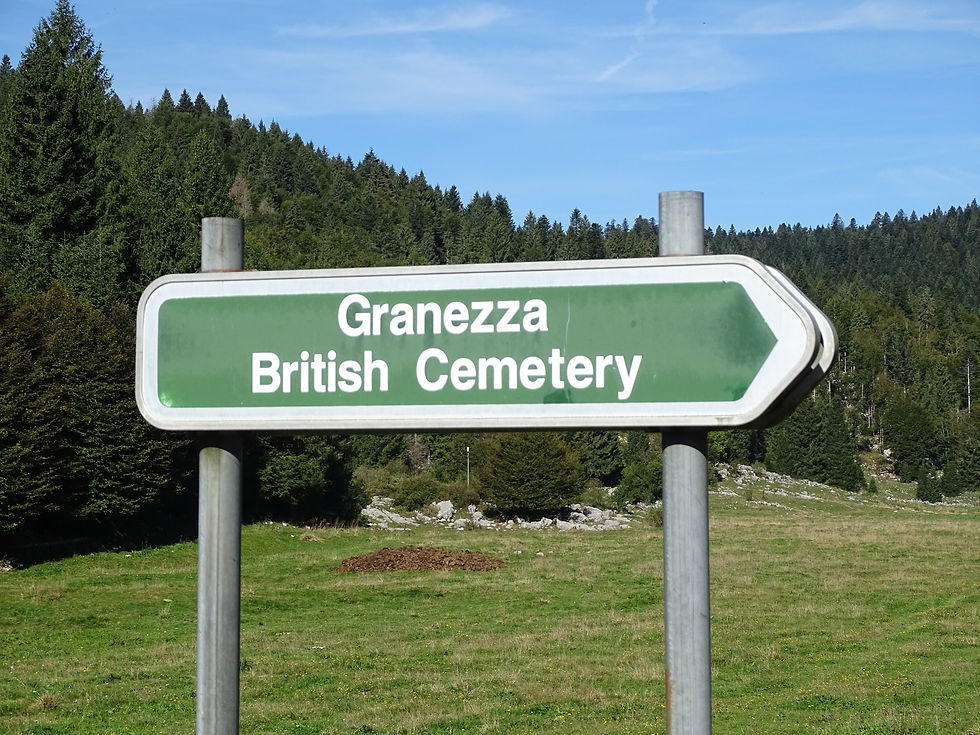
Our next stop was Granezza CWGC cemetery which stands near Tattenham Corner, a well-known spot behind the British front line and visible in the first map in this article.
In 1918 above and 2026 below.
Granezza cemetery is best known today for being the burial spot of Captain Edward Brittain of the 11th Sherwood Foresters. The exact circumstances of his death are not known, although it was reported at the time that he was shot by a sniper.
Edward Brittain was the much loved older brother of Vera Brittain, who not only lost her brother, but her boyfriend, Roland Leighton too. It was this tragic experience that prompted her to write her well known book, Testament to Youth in 1933.
Wealthy and upper middle class, the Brittains were a pacifistic and left-wing leaning family, and yet her brother and many male friends went off to do their bit for the ‘Great Cause’ and suffered as a result. Vera Brittain would go on to be the mother of Shirley Williams, the Labour MP and SDP founding member in the 1970’s.
You can read more about her here The Life and Testaments of Vera Brittain
Also lying in Granezza cemetery is Lt. Colonel James Meldrum Knox DSO and Bar…………
….Knox commanded the 1st/7th Royal Warwickshires and was killed in action on 23rd September 1918. As I left the cemetery to walk towards Tattenham Corner [and a pub! – Ed] I spotted this private memorial to Knox and all the men of the Warwickshire Brigade who served at Asiago in 1918.
The pub had a small museum of items of interest including a fine collection of British cap badges etc.
….and opposite the pub I spied a small private wayside
calvary that had been made from battlefield detritus, shell cases etc.
Searching the IWM library, I came across this photo of the Earl of Cavan talking to men of the 48th (South Midland) Diviison at Granezza in 1918. You can see how few trees there were compared to today.
I hope you have enjoyed this trawl across the San Sisto Ridge? It has whet my appetite to return at some point in the future. There will be another tale from Italy next week.
++++++++++++++
I have found another wonderful piece of work once again from Chris at Colour by CJS. Henry Tabor looks so young, and unlike so many other lads of his age, Henry survived the war.
Flight Sergeant Henry Tom Tabor MM
Henry was born in Hackney, London in 1897. On reaching the age of 18, he joined the Royal Flying Corps in August 1915 and was deployed to France later that year on 10th December.
Henry served in France and Belgium with 9 Squadron as a wireless operator and rose to the rank of Flight Sergeant.
RFC wireless operators were often attached to artillery batteries. They received Morse code signals from observation aircraft and passed target co-ordinates and corrections directly to the Battery Commander. It was vital work.
This role exposed wireless operators to enemy counter battery fire and many became casualties. For his actions carrying out this dangerous work on the 1st July 1916, the first day of the Battle of the Somme, Henry was awarded the Military Medal.
Surviving the war, Henry married Harriet Gray in 1924, before passing away in London in February 1973 at the age of 75.
++++++++++++++++++
In Memoriam the Lincolnshire Regiment 4th October.
1914
6342 Private Edward Williams, 1st Battalion. Remembered on the La Ferte Sous Jouarre Memorial, France.
9590 Private John William Williamson, 1st Battalion. – Ditto. –
1915
9794 Private James Alexander Gray, 2nd Battalion, aged 21. Buried in Bailleul Communal Cemetery Extension, France.
13721 Private F Sansam, 7th Battalion. Buried in Voormezeele Enclosure No.3, Belgium.
8218 Private S J Stocking, 1st Battalion. Buried in Etaples Military Cemetery, France.
13026 Private Walter Holvey, 7th Battalion. Remembered on the Menin Gate, Belgium.
1916
Eight men are recorded as having died on this day.
1917
Seven men are recorded as having died on this day.
1918
Five men are recorded as having died on this day.
WE WILL REMEMBER THEM.
++++++++++++++++++++++++
I look forward to hearing from you.
Until next week,
All best wishes
Jonathan
© Jonathan D’Hooghe


Comments