Trench Lincs 18th October 2026
To become a subscriber email me at trenchlincs@gmail.com You will receive TL direct to your inbox complete with all photos.
Good Morning,
Having been away for most of the week, I think this week’s TL is a slightly shorter version, but nevertheless, I hope you find a snippet of interest to keep you busy this morning.
We have news from regular contributors and another episode from my recent tour to the Italian Front.
The Lincoln WFA Christmas lunch is once again sold out and I suspect that December 12th will be upon us before we know it.
FORTHCOMING EVENTS.
Next Meeting - Lincoln & North Lincolnshire Branch, WFA – Monday 26th October 2026 - Doors open 7.00pm for 7.30pm start - Royal Naval Association Club, Coulson Road, Lincoln, LN6 7BG.
James Handley presents: "SMS Seydlitz - The Ship That Refused To Die".
James has been a regular attendee at meetings of Lincoln Branch WFA and is well known to many of you but this evening, instead of being seated in the audience, he will be in front of you presenting his new talk on the subject of "SMS Seydlitz - The Ship That Refused To Die".
Firstly, a little bit about James. He works in the world of Elections within local government, where he has developed experience working within a highly regulated, legislation-driven environment. Outside of his professional career, he has had a lifelong passion for military and naval history, with a particular interest in the history of the Royal Navy and naval warfare.
His interest in naval history began at a very young age and has been strongly influenced by his family. Both of his grandfathers served in the Royal Navy during the Second World War, giving him a personal connection to the service and its history which has remained an important part of his interests throughout his life.
Over the years he has developed a particular enthusiasm for warships, naval technology and naval warfare. His interests extend from the age of sail through to the twentieth century, although he has a particular fascination with the First and Second World Wars and the development of the modern battleship. He particularly enjoys researching individual ships and naval actions in depth, combining technical details with the wider historical circumstances in which they operated.
In this evening's talk James will describe how SMS Seydlitz (Seiner Majestat Schiff or literally, His Majesty's Ship), which was laid down on 4th February, 1911, at the Blohm und Voss shipyard in Hamburg, and commissioned in May 1913, as the fourth battlecruiser built for the German High Sea Fleet incorporated many design improvements over her predecessors in the Moltke class being bigger and heavier, at 24,988 metric tonnes. Named after Prussian General Friedrich Wilhelm von Seydlitz, she eventually became flagship of Konteradmiral (Rear Admiral) Franz von Hippers' First Scouting Group.
After completing sea trials she commenced her career in the Imperial German Navy and on declaration of war took part in several operations including the coastal raids against the English towns of Whitby, Scarborough and Hartlepool in November and December of 1914 (which you will hear about at our November 30th meeting when Dr Scott Lindgren talks about "The Coastal Raids of 1914").
James’ presentation will concentrate on the remarkable story of SMS Seydlitz and her extraordinary experience at the Battle of Jutland in 1916 when she truly became the ship that refused to die on several occasions during the battle. We will follow Seydlitz through the battle, examining her design, armament and combat performance, and the incredible damage she suffered at the hands of the Royal Navy.
Despite being battered, burning - she survived 21 hits by large calibre shells, including one that struck her aft superfiring turret which, despite causing much damage, failed to cause a catastrophic explosion thanks to safety measures introduced following experience gained from the Battle of Dogger Bank earlier in the war - and also heavily flooded due to a hit by a torpedo which tore a massive hole in her hull allowing some 5,300 metric tonnes of water to enter reducing her freeboard to just 2.5 metres, Seydlitz somehow survived and limped home to Wilhelmshaven Roads after being heavily lightened to allow passage over the Jade Bar at the entrance to the approaches into harbour.
Seydlitz, the ship that refused to die despite suffering several more experiences, was eventually interned in Scapa Flow in 1918. Scuttled by her crew in June 1919, raised in November 1928, she was eventually scrapped in Rosyth by 1930.
But what allowed her to survive through the naval conflicts of the Great War when so many other warships did not? This presentation explores the ship, her crew and the remarkable story behind one of Jutland’s most famous survivors.
Have you opened a 2027 diary or calendar yet? If you have, here are the Lincoln and North Lincs WFA speaker dates for next year.
January 11th.
February 15th.
March 22nd.
April 26th.
May - No meeting due to bank holidays and the 5-week schedule.
June 14th.
July 12th - AGM plus the Chairman's Annual Lecture.
August - Annual Memorials Tour in place of a meeting.
September 20th.
October 25th.
November 29th.
December 20th.
Plus, of course, the annual Show n' Tell event, which in 2027 will be held on Thursday, December 2nd, in conjunction with FoLT.
++++++++++++++++++++++++++++++
The next meeting of the Friends of the Lincoln Tank Group will be held on Thursday 29th October at the Royal Naval Association Club, Coulson Road, Lincoln, LN6 7BG at 7.30pm
Jonathan D’Hooghe will present a new talk – “The Importance of the Battle of Cambrai and the Men Who Made it Possible”
This talk will take a look at the opening of the battle of Cambrai on November 20th 1917, but more importantly, the talk will examine why it was so important to the BEF and the BEF’s development of warfare, that would eventually lead to the defeat of the German Army one year later, and who were the main characters behind it all?
Everyone welcome, especially new faces. You do not need to be a member of FoLT to attend meetings, but members of FoLT pay just £10 a year and receive £250 of membership benefits from Ancestry and the British Newspaper Archives. It is well worth joining.
+++++++++++++++++++++++++++++
Next Event - Spalding & South Lincs Branch, WFA is on Thursday 22nd October 2026 at 7.30pm.
Dr Scott Lindgren presents: "The Coastal Raids of 1914"
Scott is a naval/maritime historian specialising in the 19th and 20th centuries. With a Masters in Maritime History from Hull, he took his PhD at Salford under Professor Eric Grove. He spent a decade teaching naval, maritime and local history at Hull, before freelancing as a naval and maritime historian/researcher and lecturer.
We welcome him back to Spalding this evening to present his talk on "The Coastal Raids of 1914", a subject which is very much in the background of World War 1 history, and little talked about even though the incidents described caused great panic amongst the civilian populations of the East Coast of England, and concern for the Government, Royal Navy, and Coastal Defences.
The object of these raids was to entice small numbers of Royal Navy ships into open waters where they might be lured into a trap, with repeated attacks possibly persuading the Royal Navy to disperse its ships around the coast, thus weakening the Grand Fleet, and leaving it vulnerable to attack by the battleships of the German High Seas Fleet.
The raids commenced during November and December 1914, when the First Scouting Group of the German High Sea Fleet engaged in several raids on British East Coast Towns. The first raid was undertaken on November 3rd, 1914, with an attack on Great Yarmouth carried out by a German battlecruiser squadron whilst two squadrons of German battleships laid in waiting further out to sea.
Unfortunately for the Germans it was less than successful as they were intercepted by the old "coastal gunboat" HMS Halcyon and two destroyers who made smoke to conceal themselves and make rangefinding difficult for the Germans who were reported to have fired 120 shells, none of which fell beyond the beach; much to the entertainment of a large crowd who gathered to watch.
The Germans tried again in December 1914 when the First Reconnaissance Group, made up of the battlecruisers SMS Derfflinger, Von Der Tann, Moltke and Seydlitz accompanied by the armoured cruiser Blucher and backed up by four light cruisers and two flotillas of destroyers set out to bombard Whitby, Scarborough, Hartlepool and West Hartlepool, the bombardment commencing on Whitby at 08.00 hours on the 16th. Over the course of the next few hours the Germans caused considerable damage and many casualties, including 15 year-old Boy Scout George Taylor, killed during the shelling of Scarborough, becoming the only English Boy scout to die in World War One.
The only response to the German raiders came from the men of the Royal Garrison Artillery with their three 6-inch guns based at the Heugh Battery in Hartlepool. Opening fire on the German ships, they had little effect but became the only English Coastal Battery to fire its guns in anger during the war.
The raids did not succeed, as the Germans hoped, in drawing out the big ships of the Royal Navy, but did much for recruitment into the British Armed Forces with the Daily Mirror derisively printing (about Scarborough) "Many thanks von Tirpitz: you bagged some eight-odd civilians, a church and two ruins - we get two new army Corps".
Scarborough.
+++++++++++++++
Spalding & South Lincolnshire Branch WFA continues to meet at the Spalding Baptist Church, Swan Street, Spalding, PE11 1BT. Meetings continue to be held in the evenings of the fourth Thursday in the month, and doors open at 19.00 hours for a 19.30 hours start.
+++++++++++++++++++++++
The East Midlands (Nottingham) WFA branch will hold their next speaker event on Friday 13th November 2026 at 7.30pm. The branch meets at St. Peter’s Church Hall, Church Street, Ruddington, NG11 6HA and all visitors will be made very welcome.
The next speaker is John Wilson, who will present – “Were there Indians at Gallipoli.”
Indeed, there were members of the Indian Army at Gallipoli including mountain batteries of artillery.
++++++++++++++++++++++++++++
The Leadenham Military History Group’s next meeting will be on Tuesday 27th October at 7.30pm at Leadenham village hall.
The speaker on this occasion is James Handley who will speak about – “Storm Over Yorkshire – The 1644 Battle of Marston Moor.”
Probably the largest battle in terms of manpower fought on British soil. James will also bring along a selection of English Civil War militaria.
+++++++++++++++++++++++++
Another group who meet at the Royal Naval Club, Coulson Road, Lincoln, LN6 7BG, is the Lincolnshire Aviation Society.
The next meeting of LAS will be held on Thursday 19th November at 7.30pm.
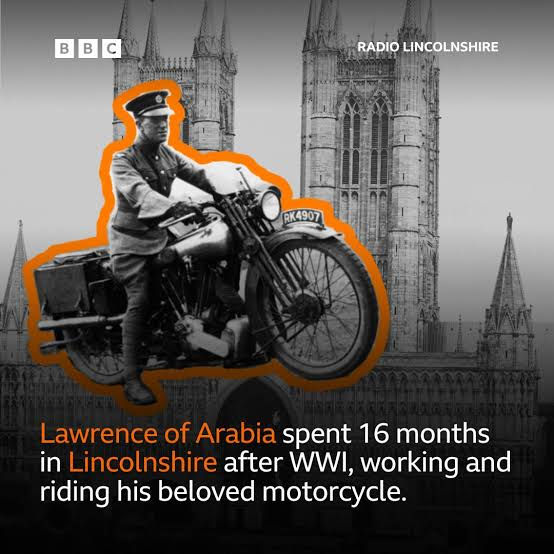
Talk Title – “Lawrence of Arabia in Lincolnshire.”
Speaker – Richard Pullen.
I am aware that T E Lawrence spent time in both Navenby and Leadenham as he wrote his seminal memoir, ‘Seven Pillars of Wisdom’, Lawrence’s most famous work, chronicling his experiences as a British Army officer during the Arab Revolt against the Ottoman Empire from 1916 to 1918. The book was completed in February 1922 and first published in December 1926. For the U.S. market, it was initially released as "Revolt in the Desert" in 1927.
Everyone welcome especially new faces.
++++++++++++++++++++++++++++++
The Peterborough Military History Group meets at the Peterborough Museum and Art Gallery in Priestgate, Peterborough, PE1 1LF, on the second Wednesday of every month, 7.30pm to 9.30pm.
Everyone welcome, especially new faces.
Wednesday November 11th - Ted Gray is the speaker.
“British and American Tanks on the Russian Front.”
Valentine Infantry Tank: This was the most numerous British tank sent to the Soviet Union, with over 3,000 units delivered. Soviet crews liked its mechanical reliability, low profile, and dependable performance in winter conditions.
Churchill Infantry Tank: The Red Army received over 250 Churchill heavy tanks. They were deployed in specialized breakthrough units and famously fought at the Battle of Kursk, where their heavy armour allowed them to hold critical defensive lines.
Matilda II Infantry Tank: Hundreds of Matilda II tanks were shipped early in the war. However, their low speed and underpowered 2-pounder guns quickly became outdated against hardening German armour.
+++++++++++++++++++++
Please click this link to read the latest newsletter from the Sleaford and District Legionnaires Aviation Society.
++++++++++++++++++++++
Two weeks ago we covered the Victoria Cross winners, Walter Parker and Surgeon General William Manley, the only man to have won the VC and an Iron Cross.
As you know, we have an expert on VC winners in our midst in Arthur Wood, who has spent many years tramping across cemeteries and churchyards at home and abroad to record the last resting place of many VC winners.
Here are Arthur’s photos.
Walter Parker VC, RMLI.
Surgeon General William Manley.
Thank you Arthur.
+++++++++++++++++++++
About four-weeks ago, I suggested that TL readers might like to pick a small war memorial near home and have a go at researching the names on it.
I thought that my suggestion had fallen on stony ground until I received an email from Alwyn Killingsworth, who writes; ‘Following my recent conversation with you, please see attached the research I have done on the small, but quite beautiful plaque, found in Fiskerton Church. I came across it on the recent WFA memorial tour. Sadly, though, I have been unable to trace anything on the final name shown on the plaque - Joseph Stapleton. If TL readers can "finish off the job", I would be pleased to see their results!
55295 LEONARD HARVEY ANDREW 1/1 Lincolnshire Yeomanry.
When Leonard Harry (Harvey) Andrew was born in 1897 in Fiskerton, Lincolnshire, his father, Edwin, was 35 and his mother, Elizabeth, was 34. He had five brothers and four sisters. The 1911 census shows that Leonard was now living with his uncle, Mr. C. Andrew, of Coleby, Lincolnshire, where he had made his home. Prior to enlistment Leonard worked for Mr. Burman, of Lincoln, as a Butcher. After enlistment he sailed for Egypt on HMT Mercian arriving there on the 21st November 1915. He died of wounds on 28 December 1917 at the age of 20, and was buried in Alexandria (Hadra) war memorial cemetery, Egypt.
201621 BENJAMIN BRUMPTON 1/4th Lincolnshire Regiment.
When Benjamin Brumpton was born in October 1890 in Lissington, Lincolnshire, his father, Benjamin, was 30 and his mother, Jane, was 40. Soldiers Died in the Great War records, that at the time of his death on the 23rd October 1917, Benjamin was residing at Fiskerton. A report contained in the 27th October 1917 edition of The Lincoln Leader and County Newspaper reads that his parents (living at Barrack – Yard, Fiskerton) had only just received news of Benjamin’s injuries. At the time of his death, Benjamin was attached to the 468th Field Coy. Royal Engineers. Benjamin is buried in Bethune Town Cemetery.
27707 Pte. SAM DRURY 2/Lincolnshire Regiment.
When Samuel Drury was born in 1896 in Greetwell, Lincolnshire, his father, George, was 33 and his mother, Mary, was 31. The 1911 census records Sam as living with his parents in Fiskerton, Lincolnshire. He was working as a farm labourer on the family farm. He died on 25 January 1918 in France, at the age of 22, whilst serving as a Private in the 2nd Battalion of the Lincolnshire Regiment. He is buried in Fins New British Cemetery, Sorel-le-Grand, France.
15921 CHARLES WILLIAM HENRY FLATTERS 8th Lincolnshire Regiment.
Charles William Henry Flatters was born in 1887 in Lincoln, Lincolnshire, the son of Mary and John. He was married in October 1909 in Gainsborough, Lincolnshire. He was the adopted son of George Warr of Mile House, Fiskerton and he died on 11th August 1918. He is buried in St. Amand British Cemetery, France.
70920 Pte. HERBERT GLOVER 9th Notts & Derby Regiment.
When Herbert Glover was born in 1887 in Nottingham, Nottinghamshire, his father, William, was 23 and his mother, Margaret, was 28. He had two brothers and three sisters. The 1911 census shows that Herbert was working as a farm labourer for Mr. and Mrs. Thomas Houlden of Fiskerton. He died on 6th September 1918 in France aged 31 and is buried in Vis-en-Artois British Cemetery, Haucourt, France.
15481 Pte. JOHN HUTESON 1st Battalion Lincolnshire Regiment.
When John Huteson was born on 21 November 1885 in Ruckland, Lincolnshire, his father, John, was 28 and his mother, Charlotte, was 25. He had one brother and three sisters. The 1911 census tells us that John was living with, and working for, Mr. James Edward Stephenson and, his sister Alice Stephenson. His address was Five Mile High Farm, Fiskerton and he was a Waggoner by trade. He died on 6th September 1916 in France at the age of 30 and is buried in Bailleul Communal Cemetery Extension, Nord, France.
20988 Dvr. ARTHUR NEEDHAM C Btn. 34th Brigade RFA.
When Arthur Needham was born in 1894 in Fiskerton, Lincolnshire, his father, John, was 31 and his mother, Rebecca, was also 31. He had one brother and two sisters. The 1911 census shows thar Athur was then living with his parents in Fiskerton and was working as a Farm Labourer. He died on 23 April 1917 in France at the age of 23, and was buried in Albuera Cemetery, Bailleul-sire-Berthoult, France.
Well done Alwyn, an excellent piece of work - Lest We Forget.
As Alwyn suggested, I had a look for Joseph Stapleton and would put forward R/3755 Lance Sergeant Joseph Stapleton, 12th Battalion King’s Royal Rifle Corps who hailed from Doddington, Lincs?
I am only using the Lincolnshire connection as there doesn't appear to be any link to Fiskerton.
Can any other TL readers come up with a suggestion?
It is important that we tell their stories.
++++++++++++++++++++
A new subscriber to TL is Amanda Brown who met Matt Colley at a talk in Sleaford recently. Amanda was just on the brink of setting off for a few days in Belgium and very kindly offered to photograph the headstones of a pair of brothers, Albert and Ernest Codling from Bourne, Lincs, who were the great-uncles of the speaker on the night, Jonathan Smith.
I was copied in to the correspondence and now have great pleasure in sharing the photographs taken by Amanda and with a little help from the internet, I also found two portraits of the brothers. It’s always special to remember the lads from Lincolnshire who served bravely in the county regiment.
Thank you Amanda.
Albert Codling is buried in Lindenhoek Chalet Military Cemetery, Belgium.
Ernest Codling is buried in Messines Ridge British Cemetery, Belgium.
+++++++++++++++++++
I continue now with Richard Godson's tour of north east Yorkshire and his next stop after Whitby (last week) was Scarborough, which ties in well with the forthcoming talk at Spalding and South Lincs WFA - see above.
Richard comments; 'Our visit to Scarborough was quite brief, but I did have time to photograph the Grand Hotel which suffered damage during the raid of 16 December 1914 by the German ships Derfflinger, Von der Tann and Kolberg. I also stumbled across a Hotchkiss QF 6lb deck gun.'
The Grand Hotel at Scarborough was damaged in the 1914 naval raid - above today, and below in 1914 after the raid.
Roof damage.
The Hotchkiss 6 pounder recovered from the sea.
Richard's next port of call was Pickering, and Richard notes; '
Yesterday, Mrs G and I took a leisurely ride on the North Yorkshire Moors Railway from Grosmont to its southern terminus in Pickering. While there we had time to visit the parish Church of St Peter & St Paul. The sun was shining very brightly through the south side clerestory windows meaning the light was shining unevenly on the memorials to both World Wars as you will see. The nave walls bear some remarkable 15th Century murals, but as they are not relevant to TL I do not attach my photographs.
However if any readers are ever in Pickering, they are well worth a visit. There were, however a number of older memorials referencing earlier conflicts or Regiments, that you might fine interesting. As was the fashion of the day, they are very verbose indeed and being very high up, were difficult to photograph clearly with my ancient iPhone 7! Look out for the 2nd Kitcheners Fighting Scouts, the 59th Foot, the siege of San Sebastian in the Peninsular War and the Leeds Volunteer Infantry.
Memorials above to Pickering's dead from both World Wars.
Captain Loy of the 2nd Kitcheners Fighting Scouts. A unit not seen before in TL.
Thomas Lloyd of the Leeds Volunteer Infantry. It was the volunteer Militias set up to guard against Napoleonic invasion, that were eventually phased out and in due course, replaced by the Territorial Force in 1908.
Memorial to Dorothy Elizabeth, an army wife accompanying her husband overseas who succumbed to Typhus. None should be forgotten.
Lest We Forget.
Thank you Richard.
+++++++++++++++
Ian Colley and his wife Tracey are also on their travels and this time in north west Ireland. Ian writes; 'Tracey and I are on holiday in Ireland and we came across the Parish Church in Donegal town.
This is amember church of the Anglican Communion covering the island of Ireland.
Please see the attached pictures
The 1914-18 Roll of Honour
Corporal Kearney is a 1st July 1916 casualty. You can read next week about the 36th (Ulster) Division and our visit last Wednesday to the Ulster Tower, but as the 12th Battalion Royal Inniskilling Fusiliers were not on the Somme in 1916, I assumed that Corporal Kearney had been drafted to another battalion, or was a casualty in fighting in Ireland after the Easter uprising.
Therefore, I looked him up. Robert Victor Alexander kearney was drafted to the 9th Battalion and was killed on the Somme on 1st July 1916. His body was never identified, and his name appears on the Thiepval Memorial to the missing.
Memorial to Donegal's WWII dead.
Here is R V A Kearney's name on the Thiepval memorial - taken last Wednesday.
Thank you for taking the time to report in Ian.
++++++++++++++++++++
Over the first weekend of October, my wife and I were on Grandparental duties for my youngest daughter and her husband. Katie and Danny snuck off for four extremely wet and thundery days in Barcelona with continual rain, whilst we basked in autumnal sunshine in Bottesford (Leics not Lincs).
Having walked the kids to school, I took a leisurely stroll back home via Bottesford’s splendid church and churchyard. One of my oldest cricketing mates died very suddenly and unexpectedly back in 2001 aged only 41 and when I am in Bottesford, I always go and have a word with him. Having done that, I spotted a CWGC headstone tucked away in the corner of the churchyard, one that I had never spotted before.
Private Thomas William Skinner died on 11th June 1918, he was the son of George and Kate Skinner of Bottesford.
Bottesford, thanks to David and Sue Middleton and their superb team of volunteers, performed minor miracles during the Great War Centenary period and now have a fabulous section on the Bottesford Living History website dedicated to the men who served and died in the Great War.
Thomas Skinner’s story is a tragic and very sad tale and I hope you will find the time to click on the link and read about him. Thomas William Skinner | Bottesford War Memorial Biographies, New contributions | Bottesford Living History
Continuing my stroll through the churchyard, I paid my respects to another old mate, Gordon Mould who died in 2012 aged 90. Some of you may remember the Mould family business?, Mould and Bloomer, Arboriculturists and Tree Surgeons.
On many occasions I enjoyed a glass of something – usually red – with Gordon, and he often mentioned his brother, Lance Corporal Ian Mould of the Gloucestershire Regiment, who died of wounds aged only 20 in Normandy in 1944. That one brother would live to be 90 and another would have his life cut short defending our freedoms reveals the vagaries and randomness of death on the battlefield. Therefore, it is only right that Gordon instructed that Ian should be remembered on Gordon’s headstone in perpetuity.
Lest We Forget.
A Roll of Honour of WW1 servicemen | Bottesford Parish 1st World War Centenary Project, New contributions | Bottesford Living History
Please do click on the link above. It is a fascinating site.
++++++++++++++++
The trip to France last week was a great success and with the extra hour of daylight being on double summer time, we spent long days in the field covering a wide area and visiting locations old and new.
I will give you an overview of days 1 and 2 this week, and days 3 and 4 next week.
Leaving Welbourn at 6am we detoured to pick up Matt in Peterborough, arrived at Eurotunnel in good time and were on the Somme battlefield by 2.30pm, having put our watches forward one hour.
First stop was Ovillers la Boiselle to pay our respects to my great uncle Jack who fell in the Great Cause here on 3rd July 1916 - longer term TL readers will know all about Jack. His body was never identified and his name appears on the Thiepval memorial. There are a condiserable number of unidentified Suffolk soldiers in Ovillers cemetery, and I am always drawn to one particular headstone, where I always place a poppy cross in memory of Jack.
Also lying at Ovillers is Captain John Lauder, the son of the music hall impresario, Harry Lauder. It was the death of his son, that prompted Harry to write the well known song 'Keep Right On To The End Of The Road'. Lauder was devastated by his son's death, and the song became an expression of grief, courage and the determination to carry on despite the terrible loss.
Next stop was Aveluy Wood cemetery, a very peaceful and tranquil location surrounded by trees.
Mike, Robin and Matt.
Robin then suggested a detour to Serre and the Sheffield Memorial Park. On arrival, we were surprised at the scale of development that has gone on in the last 12 months. A new large car park has been constructed and a new pedestrian path has been created towards the park - presumably to lessen conflict with the somewhat nutty French farmer, who has been known to give battlefield visitors a tough time every now and again!!
First stop was Serre Road No.2 cemetery - above - and we came across evidence of Jon Sandison's visit earlier in the year - below.
Complete with Shetland flag.
We then walked up the new path and I took this snap at Serre Road No.3 complete with the latest discoveries from the 'Iron Harvest'.
Arriving at the memorial park, Matt headed across No Man's Land to Luke Copse cemetery, whilst I had a mooch about towards Railway Hollow and took up to date pictures of the Barnsley and Accrington Pals memorials.
Railway Hollow cemetery viewed through the park entrance - below.
After a leisurely walk back to the car, we headed towards Gommecourt, a must visit location for all aficionados of the 46th Division and their disastrous attack on 1st July 1916. However, we stopped briefly at Hebuterne Communal Cemetery Extension.
Here in the communal cemetery, lie a number of British and French soldiers and sadly, what appears to be a complete gun team from the Royal Artillery, although Robin noted that the men are all rankers - what happened to their officer?
After the Great War ended, a surprising number of soldiers stayed on in France, married local girls and were employed by the IWGC as gardeners, as you will see next week, some lived through the German occupation of 1940-44. However, one chap, named Reginald Covey chose to be buried at Hebuterne when he died in 1975.
As you might imagine, I just had to look him up.
As you can see, Reginald Covey served with the Gloucesters and the Royal Inniskiling Fusiliers.
Arriving at Gommecourt, I gave a short talk on the actions of 1st July 1916 by the 46th (North Midland) and 56th (London) Divisions before we paid a final visit of the day to Foncquevillers CWGC cemetery, where lies John Green VC, medical officer to 5th Foresters, who we have covered here in TL in recent weeks.
We then headed to our self-catering home at Fosseux, a really lovely place to stay, where the owner, Melanie, bakes fresh bread for us from her village bakery. No wonder we return.
We awoke Tuesday to rain which fortunately soon subsided as we headed north to Neuve Chapelle. First stop was Port Arthur, the Portuguese cemetery and the Indian memorial, both of which had featured in our visit last month, but were all new locations for Matt Colley.
We then moved on to Fromelles and the Pheasant Wood cemetery, only to find that the visitor centree is closed on a Tuesday. Nevertheless, we visited once again, Rouge Bancs, where Charles Sharpe won his VC in May 1915, and the Australian memorial and VC Corner.
As lunchtime approached, it was time to set off for Auchy les Mines and the annual service of remembrance at the Hohenzollern Redoubt. First stop was at Quarry Cemetery before we ate our lunch in the farmyard as the congregations arted to gather.
There was a good turnout, better than in 2025, with several UK visitors, including Steve Bramley and his wife in attendance. A number of members of the Durand Group, broke off their archaeological dig at Haisnes to attend too. It was also time to catch up with local historian Jean Luc Gloriand and the farmer on whose land the Redoubt sits today, Michel Degourge.
As ever, the service entailed the town mayor and Mike Credland laying wreaths, the blowing of the Last Post (by machine), a salute from the French Veterans of Souvenir Francais and Mike reciting the Exhortation.
Following the service, everyone was invited to the Salle des Fetes for refreshments, following the Mayor's speech. This year, the Master of Ceremonies, Jean Claude, asked me to deliver the Mayor's speech in English, which I was delighted to do.
After beer and cake, we set off for Vermelles and a viist to the 'old' 46th Divisional memorial, we then paid our respects to Lieutenant John Kipling in St. Mary's ADS Cemetery, before a final visit to Loos, which included Dud Corner, Hill 70 and the new British Loos Cemetery Extension.
The day ended with a mighty burger and chips in a Loos town centre cafe, befor we headed home for a bottle of red and some cheese and biccies - all in all, a perfect day.
I will continue the tale of our tour next week.
++++++++++++++++
I return now to my recent tour to Italy where I had the great experience of walking in the footsteps of Erwin Rommel. Rommel is best known to us as the ‘Desert Fox’ of WWII fame in North Africa, but he had commanded a Jagerbataillon in the 14-18 conflict both on the Western Front and in Italy.
In the early 1930’s, Rommel wrote a book of his Great War experiences, not only as a memoir, but as a training manual for the German army. I have had an English translation of this book on my shelves for a number of years and have read it and looked at it over the years, without really understanding the lie of the land. I have often said, that you can pore over maps and books until you are blue in the face, but you will never really understand the fighting until you have walked the terrain.
During the fighting around Kobarid (Caporetto) in October 1917, Rommel’s Jagerbataillon was tasked with attacking near Hill 1114 at Kolovrat. It is not until you pay a visit to Kolovrat, that you begin to understand how mountainous the location is.
As I gazed around on arrival, the two things that struck me was how the Italian trenches, hacked out of stone as well as dug into the pasture, are still intact and available to walk in, and the fact that a Cold War Yugoslavian sentry hut still stands in the landscape, in what was once the frontier between Tito’s Communist Yugoslavia and the free west, but is now Slovenia.
The Cold War era sentry hut stands alone today, with the WWI Italian trench clearly visible to the rear.
It must have been a lonely posting for a sentry!
Preserved Italian trench with loop holes.
The trenches are very well preserved and walkable.
What comes across in Rommel’s writing, is how he used the lie of the land, his field-craft, to deploy his men unseen by the Italian defenders. The Italian outpost line was captured intact without a shot being fired and many prisoners were taken, as Rommel wrote; “…they surprised the gun crews at their ablutions.”
Rommel continued; “We were in a narrow saddle. The bare knolls of the Kolovrat Ridge were covered with numerous earthworks, and communication trenches leading to the strongly developed position along the north slope were also visible.”
Using the ground to camouflage the attack, Rommel stated; “The number of prisoners grew rapidly and soon reached into the hundreds. It was fortunate that the camouflage concealed us from the enemy on the heights to the east and west. We captured several gun positions which had been blasted into the rock wall. Our sudden appearance in the quiet of the morning, far from the noise of battle near Hill 1114, completely disconcerted the garrison.”
Italian view showing the dead ground that Rommel's men moved up in.
As the Italian’s became aware of the mounting attack, resistance stiffened, but by now Rommel’s men were on top of the main Italian position, not only on the flanks but to the rear; “While the first heavy machine gun opened up on the enemy with a steady fire, the second heavy machine gun shortly came into action and the mountain troops on the left charged the enemy flank and rear with savage resolution.
Attacked on two sides and pressed into a narrow space, the enemy laid down his arms. Not until we were within a few yards did the Italian officers defend themselves with pistols. Then they too were overpowered. I had to interfere to save them from the fury of the mountain soldiers. An entire battalion with 12 officers and over 500 men surrendered in the saddle three hundred yards north-east of Hill 1192. This increased our prisoner bag on Kolovrat position to 1,500. We took the peak and south slope of Hill 1192 and captured another heavy Italian battery.”
The Italians were overwhelmed and trapped in their trench lines.
Rommel’s victory was complete, and being able to walk on and study the ground, and see the folds in the land which allowed the Jager troops to advance unseen onto the main Italian position gave the text in the book a whole new meaning and understanding.
Rommel's own sketches from the book are reproduced on display boards at the site.
+++++++++++++++++
Our regular finisher is the superb work of Chris Seager at Colour by CJS, and this week is no exception.
Captain Gordon Stewart Browne
Gordon was born in Kent in 1890, where his family’s home was in Faversham. He had four older brothers, and his father had twice been the Mayor of Chatham.
Gordon was known as an all-round sportsman, he was a keen cricketer and golfer and was a good game shot.
Gordon joined the pre-war Regular Army and served in South Africa for several years with the 1st Battalion, the Wiltshire Regiment and he was for a time, the battalion Adjutant.
Gordon arrived in France with his unit on 13th August 1914, thus becoming an Old Contemptible, and was soon in action. He fought in the Battle of Mons on 23rd August and was wounded on the fourth day of the 200-mile retirement to the Marne that followed.
When he had sufficiently recovered he returned to his battalion and was wounded for a second time on 17th November 1914 during the First Battle of Ypres. Gordon was evacuated to a Hospital at Boulogne but died of his wounds on 27th November.
Gordon is buried in St. Margaret's Cemetery, Rochester, Kent, and the following year, he was mentioned in Sir John French's Despatch of 14th January 1915 “for gallant and distinguished service in the field”.
Gordon Browne was 24 years old and unmarried.
Footnote
Early in the war some British servicemen were brought back to the UK for burial but the practice was not widespread. In March 1915, the British Government and military authorities issued an official ban on the repatriation of all Imperial war dead.
Captain Gordon Browne.
++++++++++++++++++++
In Memoriam the Lincolnshire Regiment 18th October
1914
6805 Sergeant George Johnson, 1st Battalion, aged 31. Buried in Bethune Town Cemetery, France.
Captain Charles George Lyall, 1st Battalion. Remembered on the le Touret Memorial, France.
Captain C G Lyall.
1915
17144 Private Arthur Leroy Sheppard, 1st battalion, aged 21. Buried in Lijssenthoek Military Cemetery, Belgium.
1704 Private H Milson, 4th Battalion, aged 20. Buried in Le Treport Military Cemetery, France.
2770 Private S Brant, 5th Battalion. Buried in Cabaret Rouge British Cemetery, France.
15989 Private G Clarke, 6th Battalion. Buried in Hill 10 Cemetery, Gallipoli, Turkey.
1916
4170 Private Robert Smalley Kennedy, 4th Battalion, aged 18. Buried in Berles Position Military Cemetery, France.
20532 Private George William Shelton, 4th Battalion. – Ditto. –
5028 Private Charles William Whitelam, 4th Battalion, aged 20. – Ditto. –
1917
9706 Private J W Taint, 4th Battalion, aged 20. Buried in Twickenham Cemetery, UK.
1425 Private H P Johnson, 10th Battalion. Buried in Welsh Cemetery, Belgium.
1918
201095 Private J R Wootton, 5th Battalion. Buried in Easton on the Hill Churchyard, UK.
241497 Private J Bullman, 5th Battalion. Buried in Sarrable Military Cemetery, France.
Second Lieutenant Frederick Pembroke Barton, 5th Battalion. Buried in Vadencourt British Cemetery, France.
238009 Private E Thorpe, 5th Battalion. – Ditto. –
WE WILL REMEMBER THEM.
++++++++++++++++++++++++
I look forward to hearing from you. New contributors are especially welcome.
Until next week,
All best wishes
Jonathan
© Jonathan D’Hooghe


Comments