Trench Lincs 17th May 2026
Email me at trenchlincs@gmail.com to become a subscriber and receive TL each Sunday complete with all photos.
Good Morning,
I shall be at Woodhall Spa show today and I do hope that you can pay a visit to say hello?
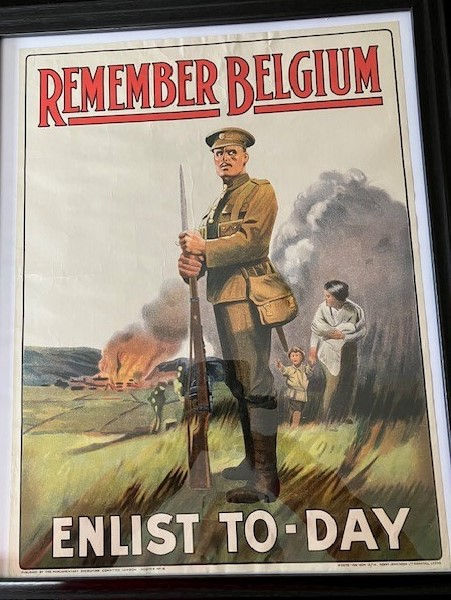
I had a very good day at an auction recently and purchased these two genuine 1914, printed on linen, British recruiting posters. Both will be on display at Woodhall Spa today.
Volunteers are always required at these events, even if it’s just for an hour or two. See Peter Garland’s request for help below.
I received lots of reader’s contributions this week, so a couple of pieces I have written, I will hold over for a future edition, otherwise you will never get to the show or into the garden today!
++++++++++++++++++++++++++++++
FORTHCOMING EVENTS.
Next event - Lincoln & North Lincolnshire Branch, WFA - Monday, 8th June 2026 - Doors open 7.00pm for 7.30pm start - Royal Naval Association Club, Coulson Road, Lincoln, LN6 7BG.
June 8th - Grant Cullen presents "Quintinshill, 22nd May 1915; Britain's worst railway disaster".
The disaster occurred at Quintinshill Junction, near Gretna Green in Dumfriesshire, Scotland, on the morning of 22nd May 1915. A Liverpool-bound troop train carrying soldiers of the 1/7th Battalion, Royal Scots, collided with a stationary northbound local passenger train that had been parked on the southbound main line due to both passing loops being occupied by goods trains. Minutes later, a northbound sleeping car express from London to Glasgow struck the wreckage, causing a massive fire when gas lighting in the wooden carriages ignited.
NB. There is no speaker meeting in May due to the Bank Holiday Mondays.
++++++++++++++++++++++++++++++
Next Meeting - Spalding & South Lincolnshire Branch, WFA – Thursday 28th May, 2026 - Doors open 7.00pm for 7.30 pm start - Spalding Baptist Church, Swan Street, Spalding, PE11 1BT.
Brian Riley presents: "The Shimmering Blue; Lincolnshire Aviation in World War One."
‘During the First World War, Lincolnshire made three major contributions to the British air war effort: home defence, aircraft manufacturing and the training of British and Allied airmen.
This talk assesses the reasons for aviation coming to Lincolnshire, explores the effects on the county of the world's first strategic air offensive, and examines the measures taken to defend the nation from air attacks. It describes how a primarily agricultural county became one of world’s largest aircraft production centres and nurtured fledgling Allied airmen on their bumpy paths to operational competence.
Over a century later, we appreciate that Lincolnshire’s men and women provided vital support to early ‘multinational coalition operations. Theirs is a story worth telling to ensure that their pathfinding efforts are not forgotten.’
Brian Riley combines a lifelong passion for military history with a love of archaeology, foreign languages and travel. He graduated with a degree in Modern Languages from the University of Salford in 1978 and worked for several years in the Civil Service and local government before deciding to make his hobby pay. He was commissioned into the RAF Education Branch at the tender age of 35 but his inquisitive nature soon led him to transfer to the RAF Intelligence Branch. Retiring from the RAF in 2012, Brian has continued to pursue his passion for aviation and military history. He led school parties on history tours of Berlin and curated the RAF Heritage Collection at William Farr School, Welton, before working for Lincolnshire County Council on a major aviation heritage project during 2017-2020. This project - Lincolnshire, Bastion in the Air 1915-18 - was financed by the Heritage Lottery Fund and highlighted the county’s important but often overlooked First World War aviation accomplishments. In October 2024, Brian was appointed by South Kesteven District Council as the official Heritage Advisor for its ‘Soldiers from the Sky’ project, financed by the National Lottery Heritage Fund. It lasted until the end of 2025 and highlighted the activities of the British, American and Polish Airborne Forces who lived and trained in the area during 1944-45 while preparing for operations in Normandy (D-Day), the Netherlands (Operation MARKET GARDEN), Norway (Operation DOOMSDAY) and Denmark (Operation ECLIPSE).
Brian is continuing his support activities with the Aviation Heritage Lincolnshire Partnership, which is a consortium of aviation heritage sites dedicated to promoting the county’s rich aviation heritage, and commemorating the service and sacrifice of all those involved.
+++++++++++++++++++++++
The East Midlands (Nottingham) WFA branch will hold their next speaker event on Friday 12th June 2026 at 7.30pm. The branch meets at St. Peter’s Church Hall, Church Street, Ruddington, NG11 6HA.
The speaker on this night is Christopher Finn whose talk is entitled – “The All-Arms Battle and Manoeuvre Warfare - British Air Power 1917-18”
Everyone welcome.
++++++++++++++++++++++++++++
The Leadenham Military History Group’s next meeting will be on Tuesday 26th May at 7.30pm at Leadenham village hall.
Presentation: Hannibal and the Second Punic War, by Ian Prince.
Back to the 3rd century BC with a look at the achievements of the renowned Carthaginian general.
+++++++++++++++++++++++++
The Friends of the Lincoln Tank Group continue their 2026 season in June. The venue, as usual, will be the Royal Naval Club, Coulson Road, Lincoln, LN6 7BG with a 7.30pm start. Entry is £5, and everyone is welcome.
NB. There is no speaker event in May.
On Thursday 11th June, in a change to the published programme, Grant Cullen will return to Lincoln with his talk – "1918, Defeat into Victory"
Grant states; ‘By starting with "What If?". Something happened in November 1913 just a few miles south of Worksop where I live which could have changed the course of history. Few people know about this but it certainly makes folks sit up and take notice.
Then to the main talk...which is basically an overview of 1918. The Allies really thought that if the war was to be won that would happen in 1919 when the Americans were up to strength in numbers on the Western Front. Then came the German Spring Offensives which brought them close to Amiens. This was followed by the "100 Days". The talk also looks at other theatres of war.... Palestine ...Mesopotamia .....Persia as well as the political situation in Russia...murder of the Tsar and his family .... plus southern Africa. The Germans reaching out to Woodrow Wilson and his 14 points.’
+++++++++++++++++++++++++++
Another group who meet at the Royal Naval Club, Coulson Road, Lincoln, LN6 7BG, is the Lincolnshire Aviation Society.
However, the next meeting of LAS will be held on Thursday 21st May 2026 with a meeting time of 6.45pm at NORTH LINCOLNSHIRE AVIATION HERITAGE CENTRE at Hibaldstow. Make your own way there.
++++++++++++++++++++++++++++++
The Peterborough Military History Group meets at the Peterborough Museum and Art Gallery in Priestgate, Peterborough, PE1 1LF, on the second Wednesday of every month, 7.30pm to 9.30pm.
Everyone welcome, especially new faces.
June 10th Geoff Turtle
'The Rising Sun Air Force.'
From Inception to Capitulation.
An in depth look at the Japanese air force in WWII.
++++++++++++++++++++++++++++++
For our June outing attendees will be travelling to Loughborough on Wednesday 24th June.
Our guide on the day is Neil Strange and he comments thus; ‘For our June outing attendees will be travelling to Loughborough on Wednesday 24th June.
First stop will be the Carillon Museum, at 11am. Loughborough Carillon & War Memorial Museum
I hope that Mel Goulding will meet us there as he is a main Leicestershire regiment historian and custodian of the museum.
Please park at the Granby Street car park, pay and display - postcode LE11 3DU around 10.45am and the museum opens at 11am.
After the Carillon we can go and see the memorial to the 10 dead from the January 1916 Zeppelin raid. We can also perhaps find evidence of the impact sites of the bombs that were dropped.
We will visit at least one grave of the dead from the Zeppelin raid as part of the cemetery tour that will follow the museum visit.’
So far, we only have 4 people booked in for this trip – please don’t be shy, everyone is very welcome to what I believe will be a very informative tour thanks to Neil.
+++++++++++++++++++++++++++++
Next week sees the CWGC cemetery tours and Steve Baldwin will be conducting tours on 23rd and 24th May at Lincoln Newport Cemetery and at Stamford cemetery.
The Lincoln Newport Cemetery tour will take place on Saturday 23rd May at 10.30am and the Stamford Cemetery tour will commence on Sunday 24th May at 11am.
You can book a place on the tours by clicking here.
War Graves Week | CWGC
+++++++++++++++++++++++++++++
David Williams is the Secretary for the Friends of the Tank Memorial Ypres Salient in Belgium and alongside their first newsletter for 2026, David writes; ‘On behalf of our Chairman I have the pleasure to share with you our First Newsletter of 2026.
This being a fresh start to our 2026 Calendar we gave our opening Ceremony a great deal of thought. We wanted to expand on our Duty of Remembrance and seek out our Tank Corps Soldiers wherever they might be.
Many Tank Soldiers lost their lives before they had a chance to step foot on the Flanders Fields, yet many of their colleagues fought on to see action on the Ypres Salient. Their story starts here in France, we Remember them and their fellow Tankies fighting to save their day.
Whilst our main concentration is based on the Ypres Salient, there are many Battles that took place leading up to the fighting in and around Ypres.
The story you are about to read was just one of the many actions that took place involving Tank Soldiers, who made a huge difference towards the outcome of the Great War.’
Please click on this link to read the newsletter.
+++++++++++++++++++++++++++++
Bill Pinfold has spotted that the film, ‘Landship’ is on at the Kinema at Woodhall Spa and writes; ‘I just booked my ticket for the special showing of Landship on 1st July at Woodhall. Is anyone else from Lincoln Branch going?
There are only a few seats left, a bargain at £10
You can watch a two-minute trailer for the film by clicking on the link below.
++++++++++++++++++++++++++++
Two weeks ago, we covered Jonty Wild’s trip to the southern end of the Western Front where the German, Swiss and French borders all meet. Jonty suggested that he was looking to run this tour once again in the future but just to avoid confusion, Jonty notes; ‘Clarification: 2027 Battlefield Tour (Trench Lincs 3/5/2026) – Jonty Wild.
Sorry if I was the source of any confusion, just to be clear, although we would like to go back to the Swiss end of the Western Front at some point, it won’t be in 2027. The 31st of July 2027 is the 110th anniversary of the Hertfordshire Regiment’s catastrophic ‘battle at St Julien’ (3rd Ypres, Belgium), when of the 20 officers and 600 men who went forward, 459 men were killed, missing or wounded. This was 100% of the Officers and about 75% of its Other Ranks, and so that is where we will be going.
Although the 31st will primarily be a study of the battle by walking the ground with three guides and the laying of wreaths at Menin Gate, I believe this will be of wider interest than just those interested in the Hertfordshires. In any case, although not yet planned in detail there will be plenty of other visits of interest to everyone.
It will be a two-night, three-day tour based at the Novotel in Ypres and visits currently under consideration include: the private museums at Pond Farm and near the Brothers In Arms memorial, the renewed Memorial Museum Passchendaele 1917. On this visit we will be avoiding the more commonly visited sites (except Menin Gate). Anyone interested would be welcome and currently we are just inviting a ‘no commitment’ registration of interest and those registered will receive the details first. If you want to see those just email me at jontywild@hertsatwar.co.uk. I am pleased to say that we already have a good level of interest.’
+++++++++++++++++++++++++++++++
As mentioned above, Peter Garland is looking for able volunteers to help out the Lincoln WFA at various shows over the summer months. Peter states; ‘Call out for volunteers to man our stands and items of interest to exhibit at upcoming local events.
Over the next 3 months Peter Garland will be organising exhibition stands promoting the Lincoln & North Lincolnshire and Spalding and South Lincolnshire Branches of the WFA, plus the general story of World War One through the display of stories and items of interest from the period. This year's display - thanks to the loan of storyboards and medals created by Matt Colley and his colleagues for the Old Contemptibles Exhibition at Peterborough Museum - will concentrate on the story of the Old Contemptibles Association. The story of the O.C.A. is quite fascinating and the display, based on extensive research by Matt and his colleagues, is extremely good and thoroughly deserving of further public display, hence Peter's request to borrow it for local Lincolnshire exhibitions.
In addition to the above, further items of interest from the period of the Great War, plus volunteers to help "man" the stands would be greatly appreciated. We do have a lockable display case in which to place items of value and volunteers receive free entry to the shows, plus free parking in the exhibitor’s car park. You can volunteer for a couple of hours, a day or both days (at the two day events). Please contact Peter on 07933-287316 or pcg1418@gmail.com Any and all help will be appreciated.
The first show will be the one day Woodhall Spa Country Show on Sunday, May 17th which Jonathan has mentioned in previous TL's and will be underway by the time you read this. We have 3 x free exhibitor tickets to give away - which can be emailed to you - so if you're reading this early Sunday morning, it's not too late to come along and visit the show in return for helping out on the stand for a couple of hours.
The second will be the two-day World War One Exhibition over the week-end of Saturday, June 6th and Sunday, June 7th at the Museum of Lincolnshire Life in Lincoln. This annual exhibition is extremely popular, attracting large numbers of visitors - including overseas tourists - some of whom turn up with family mementos, letters, photos and medals from the period which they proudly show and, at the same time, look for answers to questions they have about them and their relatives' experiences. As a bonus, museum staff keep us well supplied with free tea and coffee during the day! Tickets and car passes are not required to help out at this event.
The third will be Heckington Show over the week-end of Saturday, July 25th and Sunday, July 26th. We have 3 x free exhibitors ticket and car park passes per day (which will be posted to you nearer the time) for this excellent and well attended show - dubbed the largest village show in the country - at which we will be exhibiting in the Heritage Tent. There is a lot to see and do at Heckington Show, and we will give volunteers time-out to enjoy the attractions. As a bonus, if you volunteer for Saturday, you will be able to enjoy the evening music concert and fireworks display.
Don't be shy! Please help out by volunteering. You'll have a great day, guaranteed!’
+++++++++++++++++++++++++++++
I will start now by tying up some loose ends from last week. Mike Credland, who is Mr Metheringham writes; ‘From your In Memoriam column in Sunday's TL I append very brief details of Corporal Arthur Hannath, one of the 42 lads listed on Metheringham War Memorial. You will read that Arthur and his wife Blanche suffered a series of tragedies that illustrated the stoicism shown by their generation.
Corporal Arthur Hannath
The son of William and Lavinia Hannath, Arthur was born at Scarborough on 21 May 1892 and he had two sisters. The family moved to Sleaford in 1893, but tragically his father died on 21 April 1894 following a freak accident playing in goal for Sleaford Ramblers at Helpringham. After leaving school in 1907, Arthur became an apprentice cabinet maker and was later employed on the Lord Londesborough Estates at Blankney. He played cricket for Blankney and football for Metheringham and married Blanche Olive Pikett from East Stockwith near Gainsborough on 02 August 1915. They lived in Mill Lane, Metheringham and had a daughter, Ethel.
In 1916 Arthur enlisted at Lincoln with the 8th Battalion The Lincolnshire Regiment and was posted over to the Western Front. They were heavily engaged in the Third Battle of Ypres and Arthur was wounded a second time and badly gassed. Following treatment, he was transferred to the Labour Corps and after the war returned to work at Blankney. Following a lingering and painful illness from being gassed he had to relinquish his job and sadly died on 10 May 1920 aged 27. Although given a full military funeral at Metheringham Cemetery, with a Lincolnshire Regiment detachment firing three volleys over his grave, he was never given an IWGC headstone. I discovered this whilst researching the village war memorial over 30 years ago and through long correspondence with the CWGC he was finally acknowledged after 76 years.
His wife Blanche gave birth to a son two months after Arthur's untimely death and given his father's name. She had two brothers who served in the Great War and the eldest, Private Herbert Pikett, was killed with the 1st Lincolns on 27 May 1918. I found his grave by pure coincidence a couple of years ago whilst on the Chemin de Dames. Blanche remarried five years after her husband's death and had four more children. The eldest, Philip, was accidentally killed on his motor cycle in Metheringham by a Lincolnshire Road Car bus. Along with other Wolf Cubs waiting for the bus, we saw the accident happen. Blanche died in 1978.’
Arthur Hannath and his wife.
Newspaper confirmation of the CWGC agreeing to give Arthur a headstone.
Arthur's CWGC headstone at Metheringham.
Thank you Mike for sharing that very sad tale with us, and you are to be congratulated on your work to secure a CWGC headstone for Arthur. See also a tale from Judith Good, below.
+++++++++++++++++++++++++++
My piece last week on the ramifications, both militarily and politically, for Canada following the introduction of the Ross rifle, led to two responses from David Middleton and Tony Nutkins.
First up is David who notes; ‘Thank you for a very interesting edition of TL.
The piece on the Ross Rifle is very informative. It reminded me of the impact of the Ross Rifle appeared to have had on Charles Pacey's wartime service.
Hopefully you will click on the link to read the story of Charles Pacey, a Bottesford man by birth who had emigrated to Canada before 1914 and who served in the Canadian Expeditionary Force.
If, however, you don’t have the time, the pertinent paragraph that david is referring to reads like this.
“This would be his first and only leave home to see his family in Easthorpe. That February it snowed and photographs show him outside in the snow with family members and standing against the picket fence holding his rifle. He is still wearing combat clothes with trench wear and tear on his unpolished boots.
His rifle, a Canadian issue Ross rifle, would leave its mark on his home and his subsequent life at the front. An ungainly and heavy firearm, over 5ft in length with attached bayonet, it gouged the ceiling of his parents’ cottage in Easthorpe. Mrs. Audrey Pacey remembers that mark as unrepaired for many years.
The Ross rifle was unreliable, jamming if the breech became slightly dirty. It was also prone to back-fire causing severe injuries if the bolt was not securely in place. Its length and weight at 9lbs. 4 oz., made it unsuited for close quarter combat and the bayonets were prone to falling off in charges. It was only in service because General Sam Hughes, Canadian Minister of Defence, had insisted on its production and issue to Canadian forces. Hughes’s disdain of political control would result in his enforced resignation in late 1916. The Ross rifle was subsequently withdrawn from general service in mid-1916 and Canadian forces were issued with the British Army standard Lee-Enfield Rifle.
Punishment
A ‘dirty rifle’ would bring major problems for Charles Pacey. His records show that on the 17th July 1915 he was put on a charge:
(1) Insolence & using obscene language to NCO
(2) Dirty Rifle – 21 days FP No.1 (17/8/15)
Field Punishment No. 1 (FP No.1) was both degrading and severe. It involved being tied to fixed object such as a gun carriage, two hours at a time, for up to three days out of four, to 21 days in total. In addition, this punishment resulted in total loss of pay and hard labour for as long as it took to administer.”
Sadly, Charles Pacey did not survive the war and the biographies that can be found on the Bottesford History website are superb and are really worth reading.
1st World War Service Biographies | Bottesford Living History
**
The second response I received about the Ross rifle came from Tony Nutkins and can only be described as a highlight of my week. I hope you think so too?
Tony writes; ‘Afternoon Jonathan and thank you for yet another superb edition of Trench Lincs packed with a great variety of excellent items of interest and extensive research.
I found your piece on the Canadian Ross Rifle particularly interesting as I have read a deal of information on this weapon and this phrase caught my interest.
"There were even reports—though sometimes exaggerated—of the rifle being incorrectly reassembled in a way that could cause it to fire backward, posing a danger to the user."
I had this report face to face and direct from the man who had experienced just such an incident. I have no reason to doubt the veracity of his description of the event which occurred during his training with the East Surrey Regiment after being called up in 1940. During his medical he was found to be slightly long sighted and was sent to an optician in Guildford with a prescription for two pairs of Army specification glasses. He, like many others, was issued with the Ross Rifle as at the time there was a shortage of all small arms after the fighting in France and the Dunkirk evacuation. He wore the glasses on the firing ranges although they made only a slight difference to his eyesight and even shooting without glasses he managed to pass out as a first class shot.
On one occasion, when he was wearing his glasses, the Ross he was using had been reassembled without the bolt having been locked. On firing, the bolt flew backwards, broke his glasses which deflected it slightly, grazed his cheek and it took a nick out of his ear on its way past. Fortunately, he had only some superficial cuts and bruising from the incident and after the inquiry as to the cause of the incident he enjoyed another trip in to Guildford for a replacement pair of glasses...
The man in question was my uncle who, as he described it, spent three years defending the South Coast against German invasion. At Pevensey, his allotted position on the defences was in a length of concrete sewer pipe on a shingle beach. A fully paid up member of the suicide club if the Germans had turned up as he described it. Interestingly he also described one of the measures put in to place on some of the beaches where it was thought that an invasion might be attempted, here, there were pipelines laid in to the sea to pump petrol out which would be ignited to deter invaders.
In 1943, for a competition on the firing ranges, his Company Commander put up £5 as a prize for the best shot with the rifle. He won it, without his glasses, and firing a Ross which had been double checked. His Platoon Sergeant congratulated him and added, "You silly bastard! You've just shot yourself on to the next draft for Italy!" The East Surreys had recently suffered heavy casualties during the initial landings at Salerno.
True enough, he was in a transit camp in Italy when he was called out during the night and told that he was now 614720 Rifleman Terence McMahon of 2nd battalion The London Irish Rifles and to get on one of the waiting lorries along with a lot of other "Irishmen" from Glasgow, Liverpool, Manchester, Birmingham and London. A Sergeant with a strong Belfast accent announced that they were on their way to Monte Cassino via the Liri Valley...!’
‘Here is a photograph of my uncle - taken in a rest camp after being released from hospital subsequent to being wounded.’
Thank you David and Tony. I think we now know that it wasn’t so much that the Ross rifle could fire backwards, but that the bolt could be discharged back into the face of the firer, if it had not been correctly assembled.
++++++++++++++++++++++++++
The spread of Trench Lincs continues most weeks, and there have been two new subscribers in the last week. The latest subscriber, Judith Good, is also a first time contributor this week.
After reading of her work, I quickly realised that she is a lady who shares the same passion as I do, and that is to tell the story of the men and women of the Great War who served, and to ensure that they are not forgotten.
Judith continues; ‘Matthew Colley suggested you might be interested in my little victory with the CWGC in getting a first world war grave recognised under their non-commemoration scheme for the TL?
I am an avid (obsessed?) finder of war graves in the UK - I love a potter around a graveyard and a church finding war graves (and memorials) then researching the inhabitants - there is always an interesting story to find. [I couldn’t agree more – Ed]
In May 2025 I went to St Andrew’s at Sempringham - just past Bourne - to visit the war grave of Private Batterham who died in 1915. Whilst I was pottering about I found the grave of Private Wilfred Hart Harris of the 2nd Battalion Lincolnshire Regiment who died on 14th June 1919 aged 25 from the effects of gas poisoning received in France on Aug 2nd 1918.
He wasn't on the Commonwealth War Graves Commission database but I knew that he fitted their ‘criteria’ to be designated as a War Grave. So I got busy with my research (Ancestry, GRO etc.) and put together the evidence to make a case for him under the Commonwealth War Graves Commission Non-Commemoration Scheme. A few weeks ago in April 2026, I had an email from the Commission saying their Adjudication Authority has agreed with me that his should be designated a War Grave and they would now instigate a Grave Found Investigation to verify the site of his grave - in the meantime he is commemorated on their database under the online memorial section Private Wilfred Hart Harris | War Casualty Details 75486582 | CWGC
In order to help the very slow wheels at the Commission, I contacted the Church Benefice Clerk and asked if they had access to the burial records for Privatete Harris - by return email she very kindly sent a photo of his entry in their Burial Register - which has now been forwarded to the CWGC to aid the work of the Grave Found Team.
Whilst it took almost a year to grind through the CWGC process, I am delighted that his grave has been recognised and so will be swept up into the care of the Commission - and he will not be forgotten. It is so important that we find and remember these young men - wherever they lie. [it definitely is – Ed].
I have attached a few photos which help to tell the story - his death certificate, his war medal award, his burial record and his headstone.’
Burial record for Wilfrid Harris.
Death Certificate.
Silver War Badge record for Wilfrid Harris.
Wilfrid Harris's existing headstone.
I assume his private headstone will be replaced by a new CWGC headstone in due course? It was also very fortunate that the Death Certificate clearly states ‘Gas poisoning whilst on active service.’ Without this entry, the CWGC would not have accepted Judith’s evidence.
Long term readers will remember the battle that the Surr family have had with the CWGC in virtually identical circumstances, but because their ancestor’s Death Certificate does not specifically mention death by gas on active service, the CWGC have so far refused to recognise Corporal Charles Surr DCM as an official war death, when he died in June 1919.
There will be more from Judith next week.
+++++++++++++++++++++++++++++++
Matt Colley spotted this article from the Lincoln Branch of the Old Contemptibles dated 1959. The article describes the loss and the finding of an OC badge, with a twist in the tail.
“Lincolnshire Echo – 25 November 1959
City and County by THE GOSSIPER
A LOST BADGE
"Somewhere in Lincoln, I suspect, there is an old soldier of 1914, a member of Britain’s “contemptible little army” as Kaiser Bill described it, who has lost an inexpensive, but treasured possession. A reader has handed me a bronze badge of the Old Contemptibles’ Association which he picked up on Monks Road near Jellicoe Avenue recently. Its number, which presumably will identify the owner, was 9880 D.
_
Lincolnshire Echo – 28 November 1959
TWO CLAIM ONE BADGE
The Old Contemptibles’ Association badge, which a reader found on Monks Road and passed on to me has been claimed – twice! Mr G. W. Hammond, the Honorary Secretary of the Lincoln Branch of the Association called to tell me the badge, according to his records, had belonged to a member who had lapsed several years ago, since when he (Mr Hammond) had made several unsuccessful attempts to get it back. I handed Mr Hammond the badge which had been sent to me. Later the same day another man called to see me and said the badge was his!
He lives a few yards from the spot where the badge was picked up and, which he could not remember accurately its serial number he did know that one of the “prongs” of the fastening was bent. I referred him to Mr Hammond.
DWINDLING.
From Mr Hammond I learned that these little bronze badges, whose holders dwindle in number, through death, every year, and sometimes used by unscrupulous men who seek to gain sympathy from people professing to be Mons veterans. A few weeks ago Mr (ex-Police constable) Hammond saw a man in High Street wearing the Old Contemptibles’ badge. “Somehow,” he told me, “he didn’t look the sort of man who was entitled to one and so I spoke to him. After a few minutes’ conversation he admitted that he had not earned the right to wear it and passed it over to me. It belonged to a man living in Nottingham.
It was when he retired from Lincoln City Police Force 16 years ago, after 27 years’ service, that Mr Hammond became Honorary Secretary of the Lincoln Branch of the Old Contemptibles’ Association. The highest membership figure of the Branch (which includes Gainsborough)[1] was 45. But most years, death claims one or more members and, being the sort of organisation that cannot possibly recruit new ones, the register steadily goes down. The strength of the Branch today is 31: earlier in the week it stood at 32, but James Mitchell, of 31 Chaplin Street, died on Wednesday and thus passed another “Old Contemptible.”
[1] Gainsborough Branch closed in 1957 and their members transferred to the Lincoln Branch.
Here is a selection of Old Comrades badges from my personal collection, including an OCA badge like that referred to in the article. (Top left). They will be on display at Woodhall Show today.
+++++++++++++++++++++++++++++
With the holiday season now upon us, TL readers are getting out and about and Chas Parker notes; ‘Whilst I cannot compete with some of your correspondents in the last Trench Lincs, nonetheless we have just had a very pleasant tour of eastern Scotland and northern England.
Pictures attached show memorials at St. Giles Cathedral, Edinburgh, Balmoral Estate, Lindisfarne and the Hopetown Railway Museum, Darlington (from the local locomotive works). The RAF ensign hanging in the cathedral is 53 Squadron.’
All of the above from St. Giles Cathedral.
The two pics above from Hopetown.
Lindisfarne.
Chas’s excellent collection of memorials threw up the opportunity for a little additional research from me at home. So here is a little extra concerning two of Chas’s memorial photos.
The first being Brigadier General Francis Maxwell VC. Here at TL we cannot let a new VC winner go unrecognised, so here is his VC citation for the award of the Victoria Cross made to him when he was a Lieutenant in the Boer War.
“Lieutenant Maxwell was one of three Officers not belonging to “Q” Battery, Royal Horse Artillery, specially mentioned by Lord Roberts as having shown the greatest gallantry, and disregard of danger, in carrying out the self-imposed duty of saving the guns of that Battery during the affair at Korn Spruit on 31st March, 1900. This Officer went out on five different occasions and assisted to bring in two guns and three limbers, one of which he, Captain Humphreys, and some Gunners, dragged in by hand. He also went out with Captain Humphreys and Lieutenant Stirling to try to get the last gun in, and remained there till the attempt was abandoned. During a previous Campaign (the Chitral Expedition of 1895) Lieutenant Maxwell displayed gallantry in the removal of the body of Lieutenant-Colonel F. D. Battye, Corps of Guides, under fire, for which, though recommended, he received no reward.”
Brigadier General Maxwell VC.
**
On 15th November 1917 the son of another former Liberal prime minister, the Hon. Neil James Archibald Primrose, died of wounds sustained while fighting in Palestine. At the time of his death he was Liberal MP for Wisbech in Cambridgeshire, which he had represented since January 1910.
Born at Dalmeny House near Edinburgh in 1882, Primrose was the younger son of the fifth Earl of Rosebery, who had served briefly as Liberal prime minister from 1894-5, following Gladstone’s retirement. His mother, Hannah de Rothschild, who had inherited vast wealth from her father, died just before Primrose’s eighth birthday. Primrose had a close relationship with his father, sharing his fondness for equestrian pursuits.
Given his background, it was unsurprising that Primrose wished to pursue a political career after his education at Eton and New College, Oxford, where he spent more time on ‘hunting and racing and jesting’ than his studies, graduating with a third class degree in History. His political ambitions – at a time when MPs were unpaid – were aided by a legacy from his maternal great-aunt, Lucy Cohen, who left him £150,000 and her London house.
In April 1908 Primrose was selected as the prospective Liberal candidate for Wisbech. Despite various difficulties during his campaign – most significantly, Conservative efforts to capitalise on his father’s opposition to David Lloyd George’s ‘People’s Budget’ – he defeated his Conservative opponent, T. C. Garfit, by 200 votes. He more than doubled his majority at that year’s second general election in December. Considerable interest was generated by this contest because his Conservative rival on this occasion was also the son of a former prime minister: Lord Robert Cecil, third son of the 3rd Marquess of Salisbury.
Fittingly for the son of a peer, Primrose’s maiden speech, on 11 April 1910, was on the relationship between the House of Commons and the House of Lords, a highly topical issue given the Lords’ recent rejection of the People’s Budget. He declared himself ‘emphatically in favour of a Second Chamber’, but warned that ‘if the House of Lords is not radically and thoroughly changed, the country will not want a Second Chamber at all’. His father was among those who came to hear his speech. Although generally loyal to Liberal ministers, Primrose was not afraid of taking an independent line on particular issues. He was not a regular speaker in the Commons, but;
‘when he did intervene in debate he was always listened to with respect and often with admiration, for there was pith in his speeches, now and then a flash of eloquence, and many a happily-turned phrase.’
In the Commons Primrose was a close companion of Thomas Agar-Robartes, the Liberal MP for St. Austell, sitting with him ‘side by side on the third bench below the gangway on the government side’.
They had become friends at Oxford, and Agar-Robartes returned from active service on the Western Front to be best man at Primrose’s wedding to Lady Victoria Stanley, daughter of the Earl of Derby, in April 1915. Primrose was deeply affected by Agar-Robartes’ death during the Battle of Loos in September 1915, the fifth MP since 1914 to die while serving in the forces.
Like Agar-Robartes, Primrose began his war service with the Royal Bucks Hussars, which he had joined in 1909 as a second lieutenant. (His father had an estate at Mentmore in Buckinghamshire.) Keen to serve overseas, he used his connections to secure a transfer from his regiment, which had been assigned to coastal defence duties in Norfolk, in order to embark for France in September 1914.
Primrose spent the war alternating between military service and government office. In February 1915 he returned to London to take up the post of under-secretary at the Foreign Office. His Foreign Office superior, Sir Edward Grey, had been under-secretary to Rosebery when he was Foreign Secretary.
When the Liberals formed a coalition in May 1915, this post was given instead to Primrose’s erstwhile opponent at Wisbech, Lord Robert Cecil. Primrose resumed his military duties, joining the Royal Bucks Hussars (who had recently suffered heavy losses at Gallipoli) in Egypt.
In June 1916 Primrose was awarded the Military Cross, making him the most highly decorated of those MPs killed during the First World War. That September he again took office, as parliamentary military secretary to the Ministry of Munitions, and in December he reluctantly became the Liberal Chief Whip (jointly with Lord Edmund Talbot). He did not enjoy these duties, and resigned in March 1917 in order to return to active military service, reflecting that ‘I am of military age, and I feel that I ought to be doing my duty as a soldier’.
Primrose trained at Aldershot with a reserve cavalry regiment before re-joining the Royal Bucks Hussars in Egypt. He was wounded by machine-gun fire during an attack on the Abu Shushe ridge – site of the Biblical city of Gezer – and died of his wounds on 15th November 1917. He was buried at Ramleh cemetery, where his older brother, Lord Dalmeny, who was also serving in Palestine, was among those at his funeral.
Paying tribute to Primrose in the Commons, Lloyd George praised his ability ‘far above the average’ and noted that ‘in spite of the reserve and shyness which held him back, his future was full of promise’. He also observed that Primrose ‘deliberately chose the path of danger. He fell charging at the head of his troops, at the very moment of victory’. Primrose’s ‘proud and afflicted father’, Lord Rosebery, erected several memorials to him, with that in St. Giles’s Church, Edinburgh, recording that ‘his life was lovely and pleasant and he died in glory’.
[Text from the official parliament website]
++++++++++++++++++++++++++++
We return now to Sicily courtesy of Ray Sellers and go back in time some 200 years to the days of Admiral Lord Nelson.
Ray comments; ‘On a day of rest from the tour, I made good use of the time. Being a member of The Nelson Society, I visited Bronte Castello Di Maniace, better known as Castello Nelson. The edifice is an ancient monastic site, and the church still survives. There is also a Manor house there, and it was the seat of the Dukes of Bronte from 1799. The first of which was Lord Nelson. He was made the 1st Duke of Bronte by King Ferdinand III of Sicily and Naples basically for keeping Napoleon at bay.
After his death at Trafalgar in 1805, the Estate was managed by the Hood family. In 1981 the Estate was sold to the Commune of Bronte by Alexander Hood, the 7th Duke of Bronte who is descended from the daughter of William Nelson, 1st Earl Nelson 1757-1835, the 2nd Duke Bronte and elder brother and heir of Lord Horatio Nelson. The museum houses many treasures, including many paintings of the Nelson and Hood families, and of the 18th Century Royal Navy. There were local school parties visiting, whilst I was there, so interest in the site continues even today.
Photos 880, 881, 891, 961 and 962 show the memorial cross to Nelson, an aerial view of the site, and the drink glasses used by Nelson, on the eve of the Battle of Trafalgar. Though well off the usual tourist trail, it proved to be well worth the time and effort to visit, even though it is in the foothills of Mount Etna, Europe's biggest and most active volcano.’
Thank you Ray, and there will be more from Sicily next week.
++++++++++++++++++++++++
As I mentioned last Sunday, I was treated to a couple of outings last week for my birthday. One of the outings saw my wife and I take the train to Nottingham for afternoon tea, with champagne, at The Ivy on Bridlesmith gate. [Thank you Lizzie and Amy – Ed].
As a Nottinghamian by birth, I was told at a young age, that before nationalisation of the railways, Nottingham once had three main line rails stations.
The Low Level station on London Road was operated by Great Northern Railway, the Victoria Station, now the site of the Victoria shopping centre, was operated by the Great Central Railway and the Midland Station, which is still in use today was operated by Midland Railway, later London Midland Scottish.
I have used the Midland station for years and years and yet, only last Wednesday, did I spy this 1914-18 war memorial to the men of the station workforce who served and fell in the Great War. How I have missed it previously, I do not know!
Later the same day, Jill and I were caught in a rain shower and nipped in to what was originally, the old Liberal Reform Club on Victoria Street. Some forty years ago, this lovely old Victorian building was the Victoria Club Casino and in my youth, I was a member there.
Over recent years it has stood empty, but has now re-opened as part of the Cosy Club chain of bars and restaurants [There is a Cosy Club in the old Corn Market in Lincoln’s Cornhill Quarter – Ed], the company specialises in operating from old, distinctive and historical buildings.
Having not set foot inside for many a year, I had a wander around and lo and behold, I found another Great War memorial, this time to the men of the Nottingham Artisans Club.
[Do you know of this one Peter Gilling? – Ed]
It just goes to show what is out there if you just look.
+++++++++++++++++++++++++++
Another recent outing saw Jill and I stay the night with friends in Horncastle. I know we have covered Horncastle’s War Memorial hospital before, but here is a photo for those new TL readers who are not aware that the people of Horncastle opted for a ‘functional’ war memorial, rather than just a ‘visual’ war memorial after the Great War.
Whilst wandering around the town visiting many of the antique centres, including the Old Drill Hall, where once upon a time the men of G Company 4th Battalion Lincolnshire Regiment, would have met and drilled, I came across a memorial park containing this memorial to the Horncastle men who served in the Korean War. This too, was a new one for me.
++++++++++++++++++++++++++++++
IN THIS WEEK 1915.
As Ray Sellers noted in his Sicilian piece last week, Italy’s Great War Memorials are all dated 1915-18, as they entered the war in this week in April 1915, having previously declared neutrality.
Italy’s entry into the Great War in 1915 marked a significant turning point in the conflict and reflected a dramatic shift in European alliances. At the outbreak of war in 1914, Italy was formally part of the Triple Alliance with Germany and Austria-Hungary. However, this alliance was defensive, and since Austria-Hungary had initiated hostilities against Serbia, Italy argued that it was not obliged to join the war. Instead, the Italian government declared neutrality, a decision that reflected internal divisions and uncertainty about which side would best serve Italian interests.
Italy had long-standing tensions with Austria-Hungary despite their alliance. Many Italian nationalists resented Austrian control over territories such as Trentino, South Tyrol, Trieste, and Istria, which they considered rightfully Italian because of their Italian-speaking populations. These “unredeemed lands” became central to the argument for intervention. Nationalists believed war offered the opportunity to complete Italian unification, a process known as the Risorgimento.
During 1914 and early 1915, both the Central Powers and the Allied Powers attempted to persuade Italy to join their side. Austria-Hungary was reluctant to offer territorial concessions, while Britain, France, and Russia proved more generous. In secret negotiations, the Allies promised Italy substantial territorial gains if it entered the war against Austria-Hungary. These promises were formalized in the Treaty of London, signed in April 1915. Italy was offered Trentino, South Tyrol, Trieste, parts of Dalmatia, and colonial compensation in Africa.
The decision to enter the war was deeply controversial within Italy. Prime Minister Antonio Salandra and Foreign Minister Sidney Sonnino supported intervention, believing it would increase Italy’s power and prestige. Nationalist groups and public figures such as Gabriele D’Annunzio campaigned passionately for war. However, many Italians opposed intervention, including former Prime Minister Giovanni Giolitti, who believed Italy could gain concessions without fighting. Socialists and much of the working class also resisted war, seeing it as a conflict that would benefit elites rather than ordinary people.
Despite opposition, interventionists gained momentum. Public demonstrations in favour of war, political pressure, and the secret commitments of the Treaty of London pushed Italy toward action. On 23rd May 1915, Italy declared war on Austria-Hungary, though it did not declare war on Germany until 1916.
Italy’s entry opened a new front along the Alpine border with Austria-Hungary. Fighting in this mountainous region was brutal and costly, with little territorial movement. The Battles of the Isonzo, a series of twelve offensives, resulted in enormous casualties for limited gains. Although Italy’s military performance was often criticised, its involvement forced Austria-Hungary to divert resources from other fronts.
Ultimately, Italy’s entry into the war reflected a mixture of nationalist ambition, diplomatic bargaining, and political division. While the war brought heavy losses and post-war disappointment over unmet territorial expectations, the decision of 1915 shaped Italy’s future and contributed to the wider outcome of the Great War.
++++++++++++++++++++++++++++
As ever, we shall finish with a new colourised photograph courtesy of Chris at Colour by CJS.
Corporal Samuel Arnold Gott.
Samuel was born in the village of Cross Roads, near Keighley, Yorkshire in 1892, where he lived with his parents, two brothers and a sister.
After he left school he worked with his father in the family joinery and building business, where in time, he became a prize winning draughtsman and a skilled carpenter.
Samuel enlisted in 1915 and because of his skills, he was posted to a pioneer unit, 21st Battalion, West Yorkshire Regiment. They specialised in construction, repairs, and trench maintenance often under fire.
Samuel was killed by a shell on 4th April 1917 near Arras, and was buried in Faubourg D'Amiens Cemetery in Arras.
Samuel Gott was 24 years old.
+++++++++++++++++++++++++++
In Memoriam the Lincolnshire Regiment 17th May.
1915
13447 Private W J Cross, 2nd Battalion. Buried in Longunesse Souvenir Cemetery, France.
8045 Private Bertie Garlick, 1st Battalion, aged 25. Buried in Spoilbank Cemetery, Belgium.
14260 Private H Woolsoncroft, 1st Battalion. – Ditto. –
8110 Private Joseph Turner, 2nd Battalion. Remembered on the Ploegsteert Memorial, Belgium.
1917
19196 Private William Stacey, 8th Battalion, aged 27. Remembered on the Arras Memorial, France.
241082 Lance Corporal A C Leake, 5th Battalion. Buried in Calais Southern Cemetery, France.
32749 Sergeant H A Morris, 10th Battalion. Buried in Cologne Southern Cemetery, Germany.
1918
47001 Private James Read, 11th Battalion, aged 22. Buried in Sucrerie Cemetery, France.
202239 Private C Gaunt, 2nd Battalion. Buried in hamburg Cemetery, Germany.
7772 Private A Harris, 3rd Battalion, aged 22. Buried in Doncaster Cemetery, UK.
1920
65258 Private W Henstock, Depot, aged 22. Buried in Cotgrave Churchyard, Notts, UK.
WE WILL REMEMBER THEM.
I hope you all have a top Sunday and that I may see some of you at Woodhall show later today.
Looking forward to hearing from you.
Until next week,
All best wishes
Jonathan
© Jonathan D’Hooghe


Comments